

Inspired by 4 days in Soho.
The ecommerce industry has been calling three different human experiences by the same word. Now it is building artificial intelligence on top of the misunderstanding.
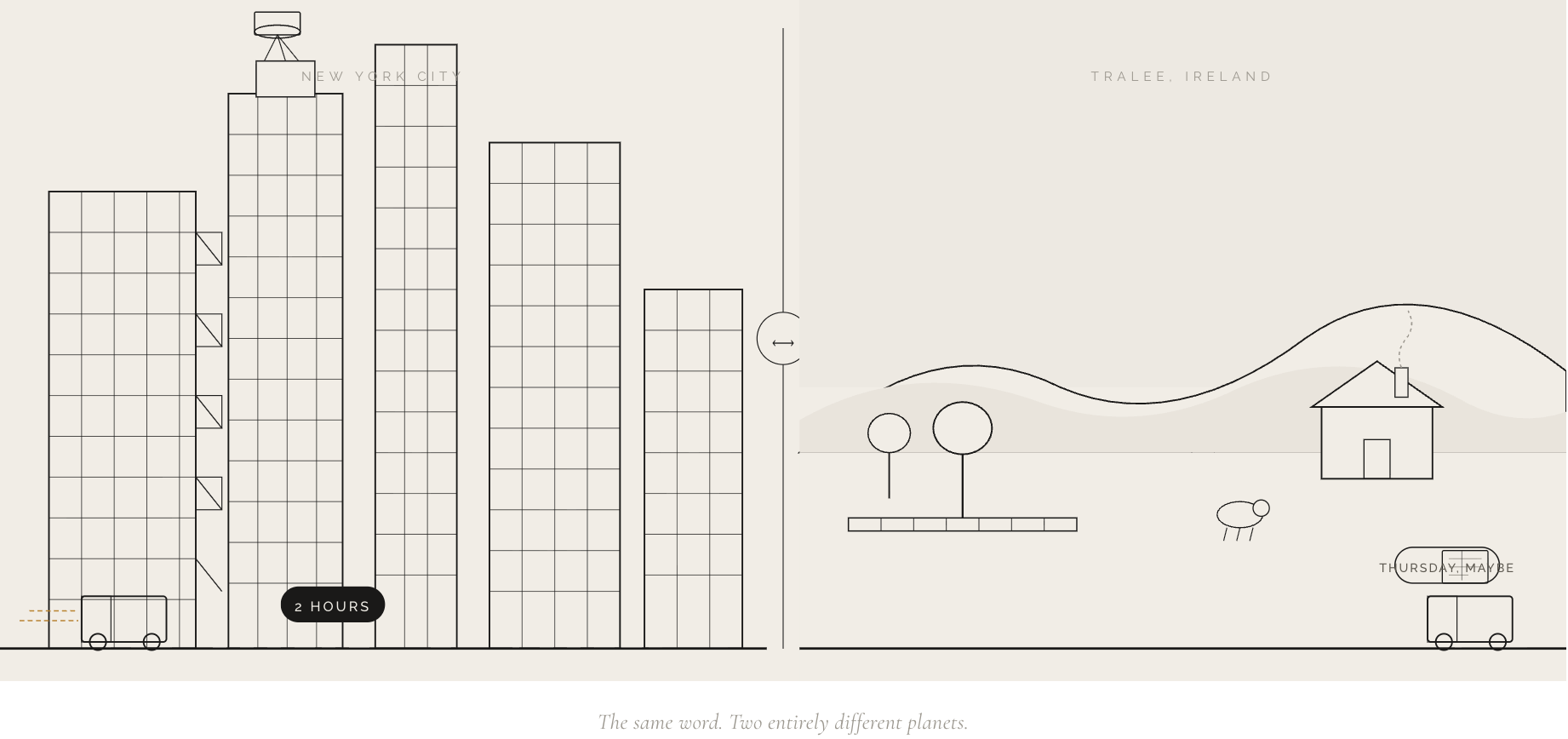
The same word. Two entirely different planets.
I was standing on a street in SoHo last week watching a man on an e-bike carrying three separate delivery bags, weaving between yellow taxis like he was late for something that had already happened. Across the street, a woman took a paper bag from a driver who had been there for six seconds and was gone in eight. An Amazon van sat double-parked at the corner, hazards blinking, treated by every pedestrian as permanent infrastructure, as natural and unremarkable as a fire hydrant or a pothole.
The whole thing had the casual fluency of a system that had been optimised so many times it had stopped looking like a system at all. Just the world, functioning.
I’m from Tralee. I watch this from a different angle.
Not a judgemental one. Not an envious one. Just genuinely different. Because where I live, if I order something at 9pm on a Tuesday, the most optimistic scenario involves a DPD notification on Thursday. The realistic one involves a “sorry we missed you” card in a door I was standing behind. Same-day delivery is not a premium feature. It is a different planet.
Standing on that SoHo pavement, I found myself thinking not about delivery at all, but about discovery. About how differently that word must be operating for every person in that street scene. And about how the ecommerce industry has been treating it as if it were one thing, for one person, in one place, in one moment of their life.
It isn’t. It never was. And the artificial intelligence layer we are now building on top of it is about to inherit the same mistake.
“Discovery has been too broad a church for too long and now we are about to make it the foundation of the next decade of commerce.”
I — The Broken Taxonomy
The industry’s definition of discovery, if you reconstruct it from the interfaces we have built over the last decade, runs roughly as follows: you open an app, you see something you did not know you wanted, you buy it. Preferably without leaving. Discovery equals inspiration equals conversion. Clean loop. Fundable thesis. Infinite scroll.
The problem is that this is not discovery. That is window shopping with faster checkout. And the distinction matters enormously once you start asking who is discovering, what they are trying to find, and why now.
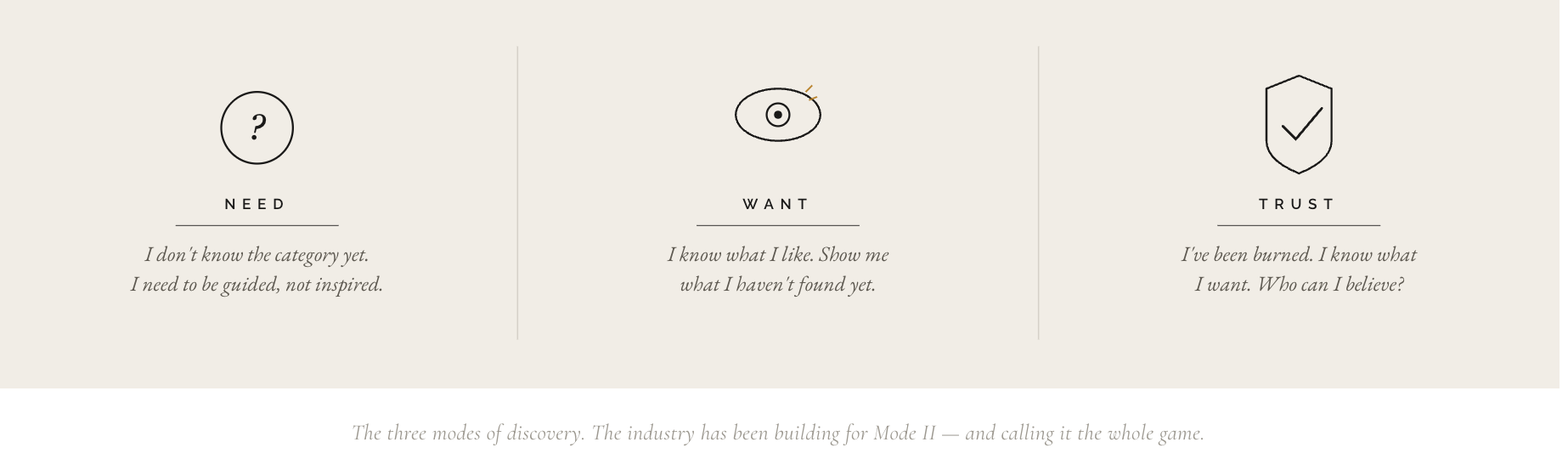
The three modes of discovery. The industry has been building for Mode II — and calling it the whole game.
There are at least three modes of discovery in ecommerce, and they have almost nothing in common except the word applied to all of them. The first is contextual need: you don’t know what you need because you have never been in this situation before. The second is want-state browsing: you know broadly what you like and you’re open to being surprised. The third is trust validation: you know exactly what you want, but you’re using discovery signals to confirm a decision you’ve almost already made or to establish that the brand can be believed at all.
The industry has been building for mode two and calling it the whole game. Every personalisation engine, every recommendation carousel, every “you might also like” is tuned to the browsing customer. That is understandable. Mode two converts cleanly, photographs well, and has a fundable thesis behind it. But modes one and three are where the real commercial opportunity lives — and where the real human need is most acute.
II — The New Parent Problem
Let us spend time in mode one, because it is the most underserved and the most interesting and because it is the mode that large language models could theoretically transform entirely.
A first-time parent does not know what they do not know. This sounds obvious. It is not trivial.
