Joy to the World (Whether You Asked for It or Not)
European ecommerce order that just got redrawn
There is a scene near the beginning of Naomi Klein’s The Shock Doctrine where she describes the playbook used by those who understand that crisis is not an obstacle to ambition, it is the precondition for it. While the ground is still shaking, the prepared move. The unprepared scramble. The gap between those two states is where history gets written.
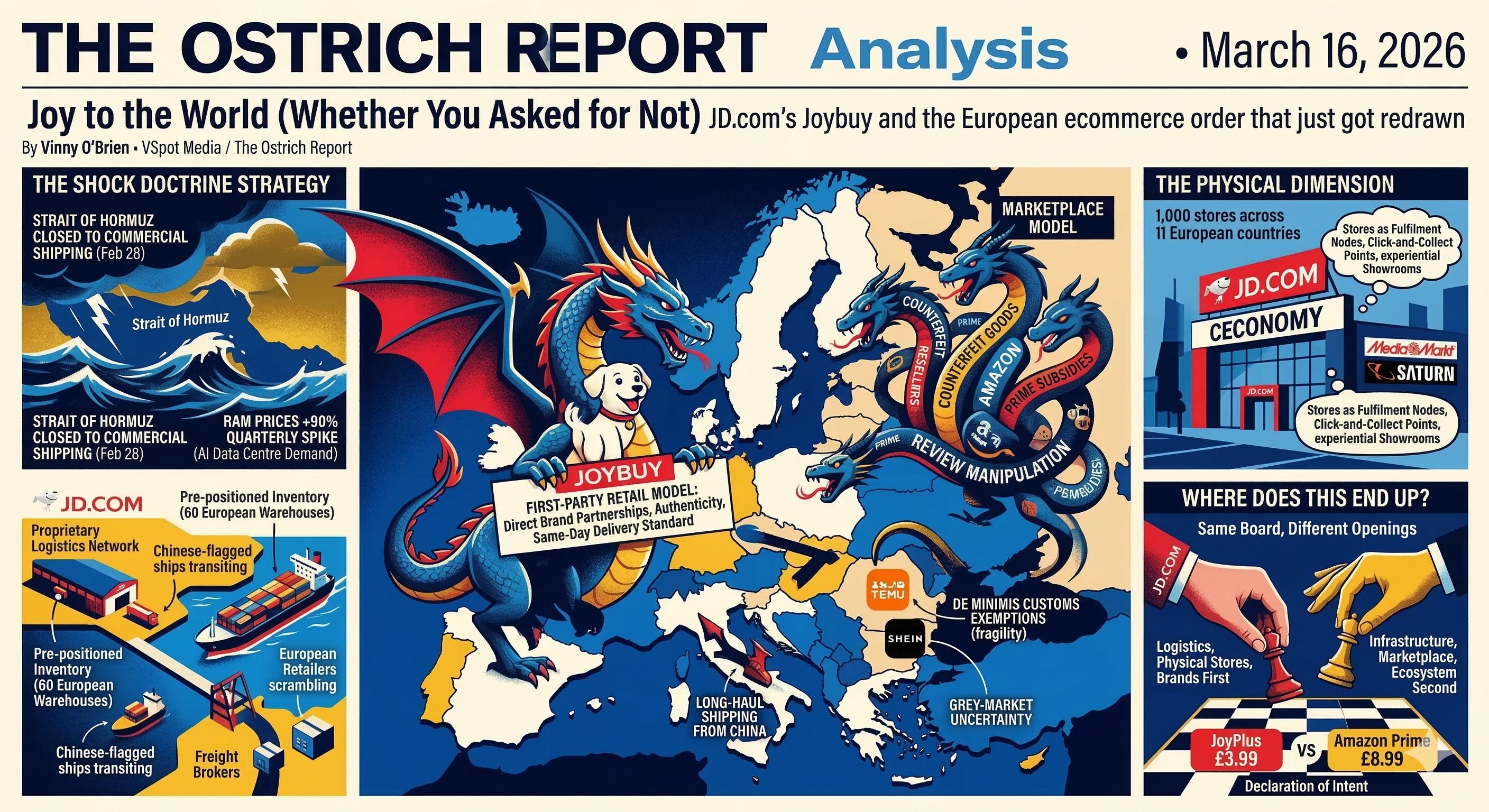
On March 16, 2026, the same morning that Iranian commanders reiterated the Strait of Hormuz would remain closed to commercial shipping, the same week that RAM prices completed a near-90% quarterly spike driven by AI data centre demand, the same fortnight that the MacBook Neo launched at a price point that rewrote what a premium laptop costs, JD.com quietly opened Joybuy for business in six European markets.
Nobody rang a bell. But something structural shifted. Martin Heubel thinks we have a genuine alternative to Amazon. This is not, he notes, Temu or Shein.
Crisis is not an obstacle to ambition. It is the precondition for it.
The Battlefield Before Joybuy Arrived
To understand what Joybuy represents, you have to understand the terrain it is entering, and the companies that shaped it.
Amazon arrived in Europe in 1998, a time when most Europeans still looked up prices in a Argos catalogue the size of a small novel. Over the following two decades, Amazon did what Amazon does: it built infrastructure first, retail second. Warehouses, logistics networks, Prime memberships, seller ecosystems, AWS-funded margin subsidies. By the time any credible rival thought to challenge it, the moat was essentially a sea.
Then came the second wave, and it arrived via a completely different philosophy. Temu launched in the UK in April 2023. Shein had been building its European presence for years prior. Both platforms shared a common operating thesis: manufacture in China, ship direct to the consumer under de minimis customs rules, price so aggressively that incumbents could not respond, and spend ferociously on social media to generate the kind of demand that traditional retail could not conjure with thirty years of brand equity.
It worked, up to a point. Temu reportedly spent over $2 billion on advertising in its first full year of US operations. Shein built a market cap at peak valuation that briefly surpassed H&M and Zara combined. Both platforms demonstrated that a significant cohort of European consumers would exchange wait times, uncertain quality, and Chinese provenance for low enough prices. The Primark generation, it turned out, had a digital successor.
But both models carry a structural fragility. They depend on de minimis exemptions that regulators on both sides of the Atlantic are actively closing. They depend on long-haul shipping from China, which, as the Strait of Hormuz crisis has demonstrated, is not as reliable an assumption as it once was. And they depend on consumer tolerance for the perception of grey-market uncertainty, which constrains them to price-sensitive demographics and makes premium brand partnerships nearly impossible to secure.
This is the gap that JD.com, through Joybuy, has chosen to enter. Not from below, as Temu did. Not from a marketplace-first model, as AliExpress did. But from a first-party retail position that is, structurally, a direct challenge to Amazon itself.
The Shock Doctrine Strategy
The timing of Joybuy’s European launch is either extraordinarily fortunate or extraordinarily calculated. In practice, those two things are often the same thing.
Consider what the competitive landscape looks like for every incumbent European electronics and general merchandise retailer right now. DRAM and NAND prices have risen roughly 90% in a single quarter, driven by AI data centre demand absorbing the production capacity of the three companies, Samsung, SK Hynix, Micron, that together control 93% of global memory supply. PC manufacturers including Dell, Lenovo, HP, Acer and ASUS have all warned of 15 to 20% price increases. Entry-level laptops under £400 are, according to Gartner, structurally unviable within two years.
Meanwhile, the Strait of Hormuz has been effectively closed to commercial shipping since February 28. Maersk, CMA CGM and Hapag-Lloyd have all suspended transits. War risk insurance premiums have reached six-year highs. The Cape of Good Hope reroute adds weeks to transit times and hundreds of dollars per container in costs. Any European retailer currently trying to restock electronics inventory is doing so at an extraordinary price premium, in a market where lead times have stretched and supply confidence has collapsed.
JD.com, as of this launch, has approx 60 warehouses and distribution depots across Europe. Their inventory was pre-positioned. Their logistics network, JoyExpress, is proprietary. Chinese-flagged ships have continued moving through the Strait while Western commercial operators anchored offshore. The vertical integration that JD.com spent a decade building in China now gives it a structural cost and speed advantage in Europe at precisely the moment its competitors are most exposed.
JD.com arrived with inventory already in the warehouse. Everyone else is still arguing with their freight broker.
The Shock Doctrine framing is not rhetorical flourish. Klein’s core argument is that the application of radical economic transformation works best when existing systems are in crisis, when the cognitive bandwidth required to resist change is consumed by the crisis itself. European retailers are managing supply chain disruption, component inflation, energy cost increases and consumer confidence erosion simultaneously. They do not have the strategic headroom to respond to a new entrant. JD.com knows this. The timing is not coincidental.
How Joybuy Differs from Amazon, and Where It Doesn’t
The First-Party Model
The most important structural difference between Joybuy and Amazon is one that Matthew Nobbs, Joybuy’s UK Managing Director, emphasised repeatedly at launch: Joybuy is a first-party retailer. It owns the inventory it sells. It is not, primarily, a marketplace for third-party merchants.
This matters enormously. Amazon’s marketplace model, which now accounts for the majority of units sold on the platform, has created a persistent quality and authenticity problem that the company has never fully resolved. Counterfeit goods, unauthorised resellers, review manipulation and grey-market inventory have eroded consumer trust in specific categories, particularly electronics and beauty. Amazon’s brand partners have increasingly complained that the platform’s structure works against them, allowing unauthorised third parties to undercut official pricing and damage brand perception.
Joybuy’s first-party approach is a direct answer to this. When LEGO, Apple, Samsung, L’Oréal Paris, DJI, and Braun appear on Joybuy, they appear as authorised partners with dedicated brand stores, full product ranges, official pricing, product launches. This is the model JD.com perfected in China, where it built a reputation as the platform global brands trusted precisely because it did not allow the marketplace-seller chaos that characterised Alibaba’s Taobao and Tmall.
The Logistics Proposition
Amazon Prime set the standard for European delivery expectations. Two-day delivery became table stakes. Next-day became common. Same-day in major cities was the premium tier. Joybuy launched with same-day delivery as the baseline offer for orders placed before 11am, across more than 15 million households. JoyPlus, the membership programme, is priced at £3.99 per month against Amazon Prime’s £8.99. These are not incremental improvements. They are deliberate weapons.
The 60-warehouse European infrastructure enabling this took years to build and was not assembled in response to the current crisis. JD.com began its European logistics experiment with Ochama in the Netherlands in 2022. That was the proof of concept. Joybuy is the commercialisation of the learning from that experiment. The deep pockets, JD.com reported $27.6 billion in cash reserves as of Q1 2025, mean that subsidising this network through its early years of low utilisation is financially survivable in a way that it would not be for most competitors.
The Category Question
Amazon is everything. Joybuy, at launch, is a curated version of everything, tech, appliances, beauty, homeware, grocery. The brand roster at launch is revealing: Apple, Samsung, Sony, LG, Philips, HP, Lenovo, Hisense, TCL, Xiaomi, DJI, PlayStation, LEGO, L’Oréal Paris, Braun, De’Longhi, Emma, BRITA, Bodum, The Pink Stuff, Nutribullet.
Two things stand out. First, the electronics weighting is heavy, this is JD.com’s core competency in China, and it maps neatly onto the Ceconomy acquisition which brings MediaMarkt and Saturn into the physical estate. Second, the inclusion of brands like Emma (mattresses) and the full large appliance installation service signals that Joybuy is targeting the high-AOV, complex-fulfilment categories where Amazon has historically underperformed, the ones that require white-glove delivery, installation and recycling logistics that a warehouse-and-van model handles poorly.
The Physical Retail Dimension
The Ceconomy acquisition, 1,000 stores across 11 European countries, €22.4 billion in revenues, the MediaMarkt and Saturn brands, is the element of the Joybuy story that has received least analytical attention relative to its strategic significance.
Amazon has tried physical retail and largely failed at it. Amazon Go, Amazon Fresh, Amazon Books, Amazon Style, each experiment has been scaled back or closed. The company that built the most efficient online retail infrastructure on earth has, repeatedly, failed to translate that competency into stores that Europeans actually want to shop in. The reason is not logistical. It is cultural. European retail is, in many categories, a social and experiential activity. MediaMarkt and Saturn, despite the frequent jokes about aggressive in-store sales staff, are genuinely embedded in the consumer electronics purchasing culture of Germany, Austria, the Netherlands and beyond.
JD.com, through Ceconomy, inherits this cultural embeddedness. The commitment to maintain Ceconomy’s operational independence, brand architecture and management continuity for at least three years is not merely a regulatory concession, it is a sensible strategy for a company that knows it does not yet understand how to operate European physical retail. Let the asset continue doing what it does well while the digital and logistics infrastructure is built around it.
Amazon tried physical retail and kept retreating. JD.com bought 1,000 stores that Europeans actually use.
The medium-term opportunity is clear. MediaMarkt and Saturn stores become fulfilment nodes for Joybuy’s same-day delivery network in the cities where they are located. They become click-and-collect points. They become experiential showrooms for the brands that have dedicated digital stores on Joybuy. They become the physical evidence of JD.com’s commitment to the European market that no purely digital player can replicate.
This is the omnichannel play that every consultancy has been describing to European retailers for fifteen years. The difference is that JD.com is not consulting about it. They are doing it, at scale, backed by a balance sheet that can absorb the losses required to establish the flywheel.
The Brands Caught in the Middle
For European and global brands currently selling through Amazon, the emergence of a credible first-party alternative with superior logistics, better brand control, and a Ceconomy-backed physical presence is strategically significant. The question is not whether to engage with Joybuy. It is how quickly, and on what terms.
The brands already on the platform, L’Oréal Paris, Apple, Samsung, LEGO, DJI, have made their calculation. These are not small accounts testing a new channel. These are brands that have experienced the limitations of the Amazon marketplace model first-hand and are hedging their distribution risk. LEGO in particular is a useful signal. LEGO’s brand protection standards are exceptional. They do not appear on platforms they have not thoroughly vetted. Their presence is an endorsement.
For DTC brands watching from the sidelines, the calculus is more complex. Joybuy at launch is a first-party model, which means JD.com is primarily buying and selling inventory directly rather than onboarding independent sellers. The marketplace layer, if it emerges, will follow. But early-mover advantage in securing brand store positions, favourable commercial terms, and preferential placement in a platform that is currently buying consumer attention through aggressive pricing is worth taking seriously.
The risk, of course, is the same risk that every Amazon seller discovered over a decade: platforms become competitors. JD.com’s Chinese private label capabilities are considerable. The moment a category becomes sufficiently large on Joybuy, the temptation to introduce a JD-owned alternative at a lower price point is real. Brands entering this partnership should be clear-eyed about that dynamic.
The Regulatory and Geopolitical Risk Layer
No analysis of JD.com’s European ambitions is complete without acknowledging the headwinds that are not supply chain or competitive in nature.
The Ceconomy acquisition received antitrust clearance from Germany’s Bundeskartellamt in September 2025. A foreign investment and national security review by Germany’s Ministry for Economic Affairs was still ongoing at the time of that clearance. JD.com’s commitment to operational independence and staff continuity is partly strategic communications management aimed at reducing the political friction of a Chinese company acquiring the largest consumer electronics retailer in Europe.
The geopolitical context has not improved since those commitments were made. The Strait of Hormuz crisis has placed US-China relations, already strained by trade tensions, under additional pressure. The fact that Chinese-flagged ships continued transiting the Strait while Western commercial operators withdrew is not going unnoticed in European capitals. JD.com launching a major European consumer platform on the same day that its ships are among the few still moving through contested waters is a compound signal that European regulators will process carefully.
The DSA and DMA regulatory frameworks give European authorities significant tools to scrutinise large digital platforms. JD.com is not yet large enough to trigger the most stringent gatekeeper obligations, but the trajectory is clear. If Joybuy succeeds, the regulatory attention will follow.
Where Does This End Up?
The honest answer is that nobody knows. JD.com has the capital to sustain losses for years while building market share. They have the logistics infrastructure that took Amazon a decade to assemble and that no other rival has matched. They have the brand relationships that give them legitimacy in the market segments where Amazon has failed. They have, through Ceconomy, a physical retail estate that is genuinely valuable.
What they do not yet have is the cultural trust that European consumers extend to platforms they have used for years. Amazon Prime is habituated behaviour for tens of millions of households. Changing that behaviour requires either significant price differential, meaningful service superiority, or both, sustained over time. JoyPlus at £3.99 versus Amazon Prime at £8.99 is a meaningful price differential. Same-day delivery as standard is a service claim. Whether delivery reliability at scale lives up to the launch promise is the test that the next twelve months will conduct.
The categories where Joybuy wins first are predictable: consumer electronics, where JD.com’s first-party model solves the authenticity problem that Amazon has never fixed; large appliances, where the installation service is genuinely differentiated; and any category where a brand with strong consumer recognition has grown frustrated with Amazon’s marketplace dynamics and is actively seeking an alternative with better brand control.
The categories where the fight is hardest are equally predictable: grocery, where Tesco, Carrefour, Albert Heijn and their peers have deep consumer loyalty and supply chains that Joybuy cannot yet match; fashion, which requires the kind of returns infrastructure and editorial curation that Joybuy has not demonstrated; and services, where Amazon’s Prime ecosystem, video, music, reading, creates a lock-in that no physical product catalogue can easily displace.
JoyPlus at £3.99 versus Prime at £8.99 is a declaration of intent.
Coda: Same Board, Different Openings
There is a chess analogy that applies here. Amazon and JD.com are playing the same game, European ecommerce dominance, but they arrived at the board having studied different openings. Amazon built the infrastructure first and the brand relationships second. JD.com built the brand relationships first, bought the physical infrastructure second, and is now deploying the logistics network it has been quietly constructing since 2022.
Both approaches can work. But they arrive at different positions on the board. Amazon’s position is dominant but increasingly under pressure from a platform that has learned from Amazon’s mistakes. JD.com’s position is ambitious but exposed to regulatory, geopolitical and execution risks that Amazon, after twenty-five years of European operation, no longer faces.
Naomi Klein would probably note that JD.com did not create the Strait of Hormuz crisis, the RAM shortage, or the moment of maximum competitive vulnerability for European retailers. But they were ready for it. They read the manual. They built the warehouses. They signed the brands. They launched on the day the ground was still shaking.
Whether the ground has shifted permanently in their favour is the question that 2026 and 2027 will answer. For now, the most important thing to understand is this: Joybuy is not a Chinese version of Temu. It is not a cheaper version of Amazon. It is a structurally different model, arriving at a structurally advantageous moment, backed by resources that allow it to absorb the costs of the market education that every new entrant must pay.
The joy, for JD.com, is that its competitors are currently paying a different kind of price entirely.
Vinny O’Brien is the founder of VSpot Media and an ecommerce consultant working with DTC brands and agencies across the US, UK and EU. The Ostrich Report is his marketplace retail and commerce intelligence publication.


