

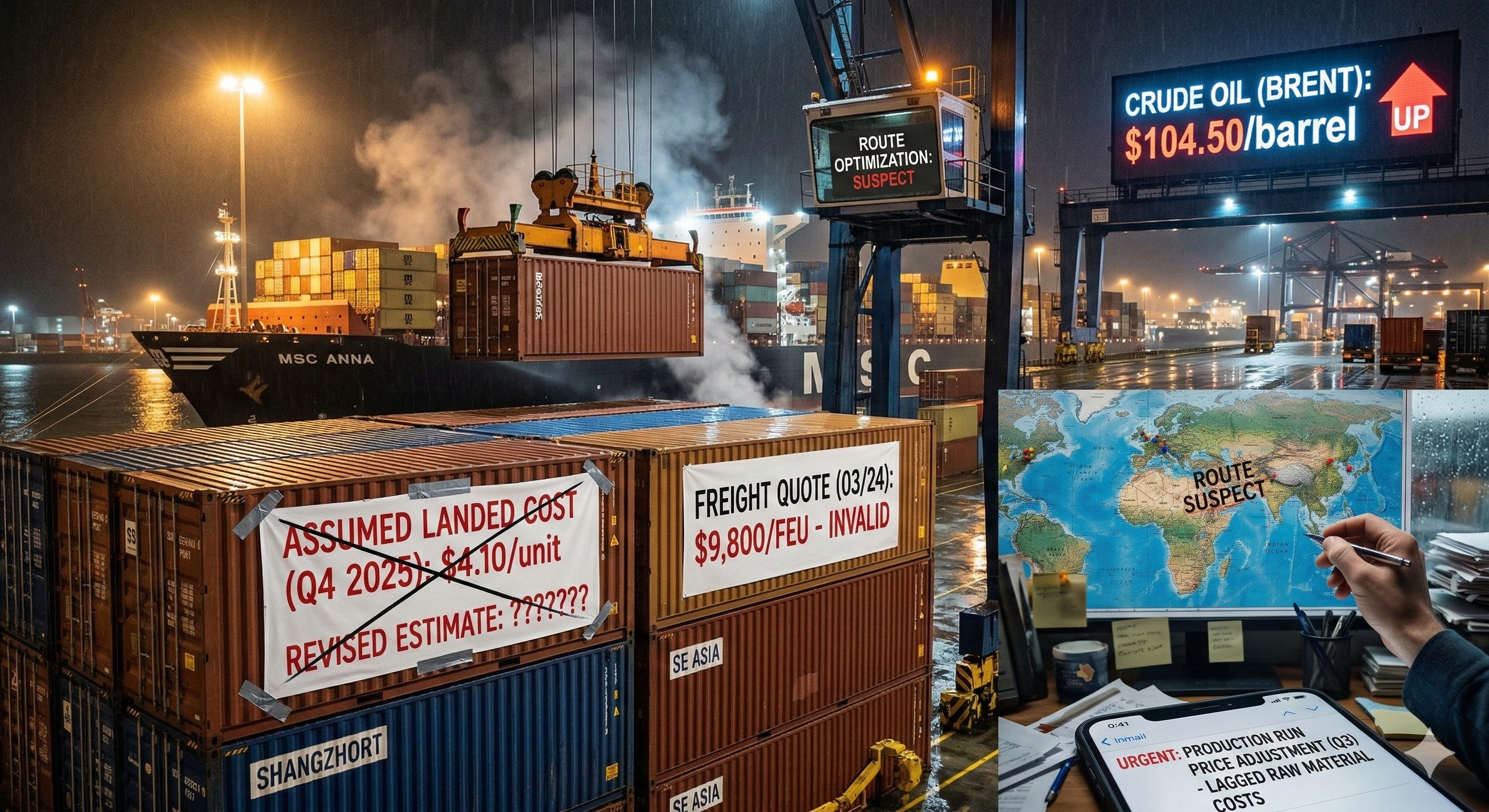
I was having one of those conversations with my friend Hendrik Laubscher today, the kind where you start with “Why is nobody talking about this” and end up two hours later having basically mapped out a slow-moving crisis that most ecommerce operators haven’t fully clocked yet or maybe they have. Maybe they are just f*ckin’ sick and tired of more things to deal with. So let me share what we were noodling on not as experts, but as people who watch this space
On March 1, the US and Israel conducted military strikes on Iran. Iran’s response has included threatening to close, or at least severely disrupt, the Strait of Hormuz. That narrow strip of water is the jugular of global trade. Right now, the numbers are stark. According to Ocean Network Express CEO Jeremy Nixon, speaking at the TPM26 conference in Long Beach on March 2, roughly 750 ships are currently backed up due to the Strait of Hormuz closure, 100 of which are container vessels. That’s approximately 10% of the entire global container fleet effectively snarled. Not rerouted. Not delayed. Snarled.
Nixon was direct about what comes next: freight rates are going up. Exports from Asia, where the majority of ecommerce product originates, will feel the brunt. Major port hubs like Singapore will lose their fluidity. Bookings are halting. Cargo already sitting in terminals is going nowhere fast.
He also noted something that should make every operator sit up: if the Strait stays closed past 25 days, Middle Eastern oil production sites will start curtailing output because they’ll have nowhere to put the oil. At that point, Nixon said, a price of $100 per barrel becomes “quite possible.” For context, Brent crude is already trading between $80 and $83 a barrel this week against an average forecast for the year of $58.
Meanwhile, diesel prices in the US have been climbing every single week since January 12. As of Monday they hit $3.897 per gallon, up nearly 9 cents in a week alone. This is already layered on top of war risk pricing for Iran and Russian sanctions that were baked in before any of this escalated. And UK natural gas was up 93% this week alone - yep, 93%.
And as one analyst put it neatly: every day the Strait is closed equals several days of recovery time on the other side. You don’t just flip the switch back.
Looking for other impacts, I dug in. The February Purchasing Managers’ Index data showed input prices surging to their highest level since 2022, that COVID-era hellscape of container rates at $20,000+ and 14-week lead times that a generation of ecommerce operators is still quietly traumatised by. This was before the full escalation. The data was already pointing upward before the bombs started falling.
This matters because PMI is a leading indicator. It’s telling us that procurement teams were already feeling cost pressure in their pipelines. What we’re seeing now is an accelerant on a fire that was already smouldering.
So What Does This Mean For Goods on the Water?
Short answer: the cost of goods on the water is going up. But that’s almost the least of it.
