

Here is Sarah’s central argument, stated plainly, because it deserves to be: the volume growth era for UK fashion retail is over.
Not slowing. Over. She presented research showing that the volume of fashion goods sold in the UK in 2028 will be approximately the same as what was sold in 2019. The rising tide has stopped rising. Every boat must now paddle for itself.
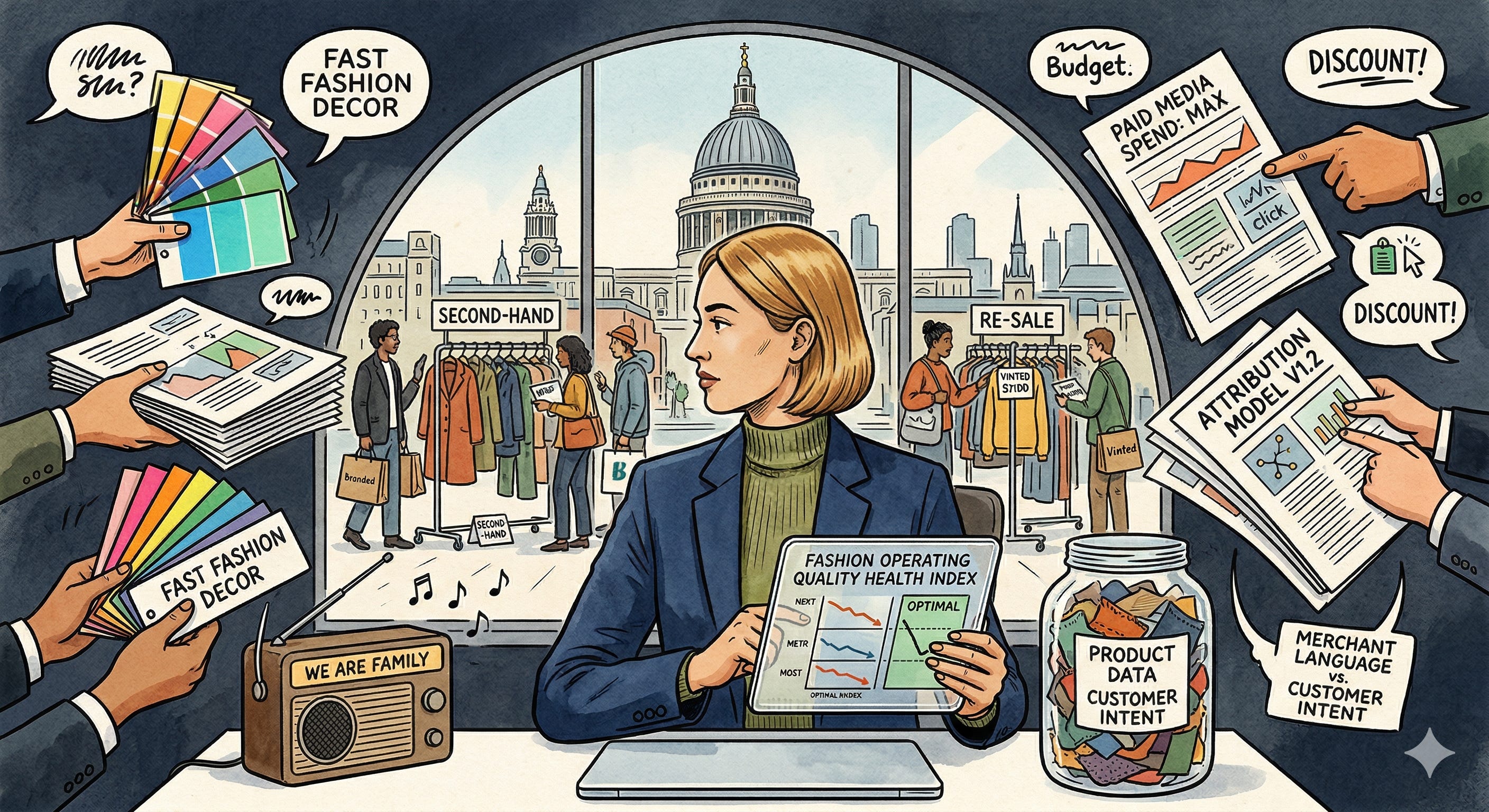
And it gets more specific than that. One in four items sold in the UK is now second-hand. Vinted, which Sarah describes with the mix of admiration and slight personal complicity of someone whose kids are very much on it, is generating revenue of around £900 million with EBIT margins around £100 million. It is, in her words, an extraordinary business, because it is a wealth creator: it turns dormant wardrobe assets into spending power, and about 36% of that money cycles back through the platform.
The Text Message That Built Everything
In 2003, before anyone in fashion retail had heard the phrase “product data enrichment,” before Vinted existed, before Shein’s founder had pivoted from SEO to fast fashion, a woman named Sarah McVittie had an idea about SMS.
She co-founded Texperts, the world’s first Q&A SMS service, inspired by her first job working as an analyst at an investment bank. In 2008, it was sold in a multi-million-pound deal to its largest competitor. Sarah was, at that point, already on her second chapter before most people in the industry had finished writing their first.
The leap from investment banking to SMS to fashion tech is not an obvious trajectory. But it makes complete sense once you understand what connects all three: Sarah is interested in the gap between what information people have and what information they need. At a bank, that gap is the whole game. At Texperts, it was the entire product. At Dressipi, which she co-founded in 2010 and built into one of the UK’s most respected fashion AI platforms, it became a mission, to decompose the product into data points as a customer sees it, and put a customer and fashion lens onto those products, to truly understand the customer’s intent in real time.
Mapp acquired Dressipi in early 2025, and Sarah moved into the role of VP of Marketing, carrying with her fifteen years of data that most fashion retailers would trade significant percentages of their margin to access.
She also brings, around Christmas week in London near St. Paul’s, the kind of energy that makes you want to immediately go and find a sandwich shop called Fuzzy’s Kitchen. Which tells you something about her too.
Who Is Sarah McVittie?
Sarah is the person in the room who has already done the maths while everyone else is still debating the question. She is warm, specific, and completely unsentimental about the state of an industry she clearly loves, which is the most useful combination of qualities a commentator can possess.
She was named by Management Today as one of the top 35 female entrepreneurs under the age of 35, and by The Times as one of the UK’s top rising female entrepreneurs. She has been writing about fashion retail’s structural problems for years, with the patience and precision of someone who built their career on understanding what data actually says versus what people want it to say.
She is also the kind of person who, when asked what song her career would be, says We Are Family by Sister Sledge, and means it completely, because she has spent two startups working with people ten times better than her at everything, and she knows exactly why that worked. That’s not false modesty. That’s the founder’s instinct for complementary capability, which is rarer than it sounds.
She is passionate about using data to drive more efficient retail experiences and operational processes, and has spent the last several years building the index that proves how few businesses are actually doing it.
The Origin: Two Startups, One Through-Line
The through-line from Texperts to Dressipi to Mapp is a single obsession: closing the gap between what a product is and what a customer needs. At Texperts, that gap was informational, people wanted answers, quickly, on a device they already carried. At Dressipi, it was personal, people wanted to find clothes that worked for them specifically, not just clothes that existed. At Mapp, it’s operational, helping retailers show each visitor the items they’re most likely to buy and keep, with products automatically tagged with three times more detail, delivering incremental improvements to profit, revenue, returns, and sell-through rate.
What she built at Dressipi was a translation layer between how merchants describe products and how customers actually think about them. Merchant language says “midi dress, polyester blend, floral print.” Customer language says “I need something for a rooftop wedding that covers my arms.” The gap between those two descriptions is, in Sarah’s framing, where most of the industry’s problems live, and increasingly, where its future is being decided as LLMs take over discovery.
She saw that problem clearly in 2010. The industry is only now catching up to why it matters.
The Share-Game Market Nobody Wants to Admit
Here is Sarah’s central argument, stated plainly, because it deserves to be: the volume growth era for UK fashion retail is over.
Not slowing. Over. She presented research showing that the volume of fashion goods sold in the UK in 2028 will be approximately the same as what was sold in 2019. The rising tide has stopped rising. Every boat must now paddle for itself.
And it gets more specific than that. One in four items sold in the UK is now second-hand. Vinted, which Sarah describes with the mix of admiration and slight personal complicity of someone whose kids are very much on it, is generating revenue of around £900 million with EBIT margins around £100 million. It is, in her words, an extraordinary business, because it is a wealth creator: it turns dormant wardrobe assets into spending power, and about 36% of that money cycles back through the platform.
