The City We Forgot To Build
What Happens When Commerce Becomes Perfectly Efficient and Nobody Enjoys It Anymore?
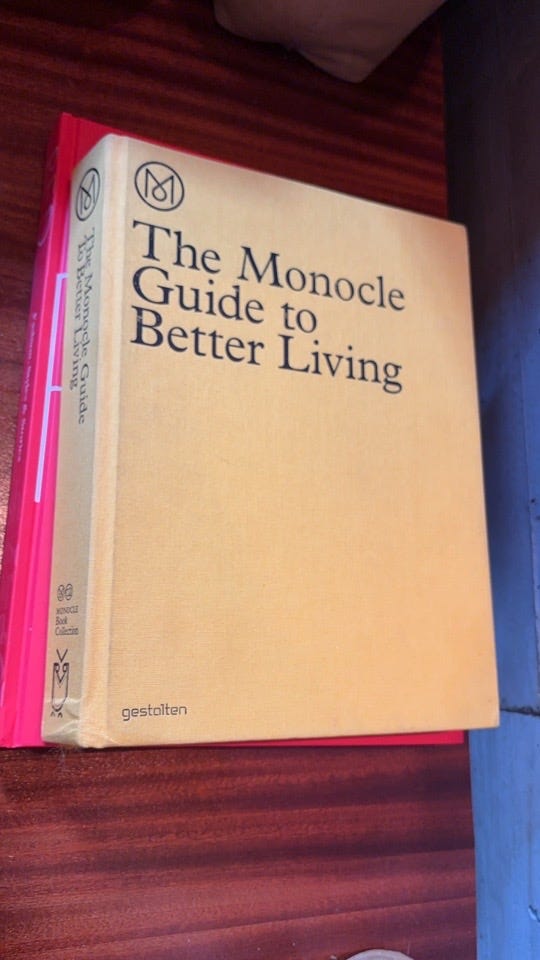
I’ve never knew Monocle. Or its guide to living. I saw it recently at a hotel and read it in Soho. I immediately sent a message to Philip Jackson, thinking I had uneartned some unknown treasure to him. As sure as his quiff is tall, he already knew. He pointed me to their London store and I will visit this summer (if still there).
I was hooked though. Not because I agree with everything they publish. Sometimes it feels like the magazine equivalent of a man who owns three cashmere scarves and believes every problem can be solved by relocating to Copenhagen. Hygge much?
But the whole thing pointed me to something greater, something more. The Monocle Guide to Better Living. The book is ostensibly about cities. Or culture. Or architecture. Or transport. Or radio stations. Or corner shops.
My head went to thinking that although it is about cities,it isn’t really about any of those things. To me is was about stewardship. I am in that place in life. Today a local school headmaster was laid to rest. His legacy is what was written on the page of his death notice. A man who positively impacted 2 generations of kids and their parents too. All enriched through kindness, thoughtfulness and a sense of time for people. A life worth living, a life worth celebrating. The page in question is here. Those who knew him wept today - love does not always earn grief. But to know was to love it appears. rip
What are the people, habits, rituals, imperfections and institutions required to make somewhere worth living?
As I moved from chapter to chapter I found myself increasingly uncomfortable.
What does it tell us about commerce. About the state of it and how we plot it forward.
Monocle celebrates street sweepers.
Morning radio hosts.
Corner-shop owners.
Property developers who actually care.
Independent booksellers.
Local rebels.
Mechanics.
People whose contribution to society would never appear on a quarterly earnings call.
People who create value without necessarily creating efficiency.
And somewhere between the chapter on neighbourhood garages and another celebrating public radio, I started thinking about ecommerce.
For twenty years we have been asking the wrong question.
The question wasn’t:
“How do we make commerce better?”
The question became:
“How do we make commerce faster?”
Those two things are not the same. Convenience became linked to accounting periods and time periods in general. Where speed counts is for the small few big guys. We have developed a poor relationship with time - patience used to be a virtue, now it is a perceived industry ill.
For most of the last two decades, the industry has operated under an almost religious belief that removing friction was inherently good.
Every conference presentation.
Every software pitch.
Every agency proposal.
Every venture capital deck.
Remove clicks.
Remove steps.
Remove waiting.
Remove uncertainty.
Remove conversation.
Remove people.
Remove effort.
Remove friction.
The result is extraordinary.
Consumers can discover, compare, purchase and return products from anywhere on Earth in minutes.
Goods appear on doorsteps faster than pizzas once did.
Payment information follows us from device to device.
Customer service never sleeps.
Recommendations arrive before needs are consciously formed.
It is, by almost every traditional measure, a miracle.
And yet.
Conversion rates haven’t moved much.
Customer acquisition costs continue to rise.
Brand loyalty feels increasingly fragile.
Most ecommerce stores look eerily similar.
Most customer experiences feel increasingly forgettable.
And perhaps most interestingly of all, nobody seems particularly happier.
The scoreboard is quietly asking a question that few people in commerce seem willing to answer.
What if friction wasn’t the problem?
What if we removed the wrong friction?
Kevin Kelly wrote in The Inevitable that successful technologies eventually disappear.
Electricity disappears.
Running water disappears.
Search disappears.
When technology works perfectly it stops being noticed.
Its greatest success is becoming invisible.
I often think about a story Kelly tells involving Larry Page.
Years before artificial intelligence became the dominant story of our age, Page remarked that Google wasn’t really building a search engine. Search engines became boring because we became lazy - we recmoved friction. The idea that any product can be available anywhere in the world means the only place differentiation goes is to price. Making local used to be a reason to discover a brand in your home town or to visit them when away to see what new cool things you could discover and piss off your neighbours. Now, we do the same holidays, watch the same reels, get the same priorities wrong. All this was building and training the basis for AI.
I often think about a story Kelly tells involving Larry Page.Then I went back to it yesterday or Monday, not sure what day it is really.
Most people laughed. At me, not Kelly. My articulation is not worldly in its composition, again, I am fine with this.
Today that prediction feels less remarkable than inevitable. (written in 2016 remember).
But hidden inside Kelly’s observation is another idea.
Invisible technologies may be successful.
They are rarely loved.
Nobody wakes up excited about plumbing. Except maybe Kelly Goetsch.
Nobody posts emotional tributes to broadband. (I once went to the opening of a 1gb fibre optic line, true story.)
Nobody gathers around a dinner table to discuss the elegance of municipal wastewater systems.
They matter enormously.
But they inspire almost nothing.
Commerce is becoming plumbing.
And that should probably concern us.
Because people don’t form emotional relationships with plumbing.
They form emotional relationships with places.
Which brings us back to the corner shop.
The tragedy of modern commerce isn’t that technology replaced the corner-shop owner.
The tragedy is that we spent twenty years trying to scale away the very thing people loved most about them.
The corner-shop owner wasn’t efficient.
He was often slow.
Opinionated.
Inconsistent.
Expensive.
Sometimes annoying.
Occasionally wrong.
And yet he knew your name.
He knew your children.
He knew your habits.
He knew what you usually bought on a Friday evening and what you forgot every Monday morning.
He wasn’t a recommendation engine.
He was something much more powerful.
He recognised you.
Dave Finnegan once made an observation that has stayed with me for years.
Customers don’t want to be tracked.
They want to be recognised.
Those are entirely different experiences.
One feels helpful.
The other feels slightly unsettling.
Modern ecommerce has become remarkably good at tracking.
Recognition remains elusive.
The irony is that we continue trying to solve this problem with more technology.
More data.
More automation.
More AI.
More prediction.
As though intimacy can somehow emerge from scale.
Maybe it can.
Eventually.
But right now most personalisation resembles being followed around a shopping centre by an enthusiastic Labrador carrying a clipboard. Vanity over transparency.
Persistent.
Well intentioned.
Completely unaware of personal boundaries.
And perhaps that explains why so much commerce feels increasingly flat.
Open ten ecommerce sites.
Then open another ten.
The differences become surprisingly difficult to spot.
The same navigation.
The same reviews.
The same subscription prompts.
The same recommendation carousels.
The same countdown timers.
The same loyalty schemes.
The same abandoned-cart emails.
The same chatbot waiting in the corner.
Different brands.
Identical experiences.
Commerce has become an airport terminal.
Exceptionally efficient.
Entirely predictable.
Almost impossible to remember.
Which is unfortunate because human beings are not optimisation machines.
We’re story machines.
We remember surprises.
We remember mistakes.
We remember conversations.
We remember discoveries.
We remember things that weren’t supposed to happen.
Daniel Kahneman spent decades showing us that people rarely make decisions rationally.
Yet much of ecommerce continues operating as though consumers are spreadsheets with credit cards.
Optimise the route.
Reduce the clicks.
Remove the effort.
Increase the probability.
And perhaps that works.
Until it doesn’t.
Because eventually optimisation begins eliminating the very moments people remember.
Discovery is one of those moments.
Perhaps the most important one.
Today the industry is understandably excited about agentic commerce.
AI agents that know our preferences.
Our budgets.
Our sizes.
Our habits.
Our delivery addresses.
Our dietary restrictions.
Our favourite colours.
The promise is seductive.
Perfect recommendations.
Perfect efficiency.
Perfect relevance.
But I can’t help wondering what happens when every recommendation is correct.
What happens when every purchase is optimal?
What happens when surprise disappears?
What happens when wandering disappears?
What happens when curiosity disappears?
Because some of the best purchases any of us have ever made were terrible recommendations.
They were accidents.
Detours.
Mistakes.
Moments of curiosity.
A book picked up in an airport.
A record discovered in a strange shop.
A bottle of wine recommended by someone you trusted.
A jacket purchased because it reminded you of somebody.
A city visited because your flight was delayed.
The stories matter more than the efficiency.
Perhaps that’s what Monocle understands.
And perhaps that’s what commerce forgot.
Monocle never celebrates efficiency for its own sake.
It celebrates the ingredients required to make somewhere worth returning to.
The radio host.
The bookseller.
The mechanic.
The rebel.
The street sweeper.
The people who don’t scale.
The people whose value exists precisely because they don’t scale.
And maybe that’s where commerce finds itself now.
Not at the beginning of another technological revolution.
But at the beginning of a human one.
Not deciding how to remove the next layer of friction.
But deciding which friction deserves to remain.


