

A review of ancestry, curiosity and the people who help us find our way. There are people I speak to in this industry who leave me with more information. Finn leaves me with more room to think. Always.
I have been trying to work out why that is. He can move from a robot destined for a space station to the aunties who raised him, from nineteenth-century canals to a company that has barely existed for a few months, and somehow you never feel that he has changed the subject. I try to do this and my best feels like a poorly wired Billy Connolly joke. But for Finn, there is a person at the centre of each story. Someone trying to understand something. Someone taking a chance. Someone whose confidence came from another person before it ever became their own. And a person knows the value behind all of this.
Dave Finnegan, Finn to his friends, has a way of making the world feel larger and the distance between us feel smaller. A gift. A rare commodity in tomorrows world.
When I opened season three of The Struggle Bus together, I read him a passage from Bill Bryson about ancestry. (full text in the LInkedin POst) Follow the generations backwards and the family tree becomes an extraordinary crowd of people whose meetings, choices and circumstances eventually made you possible. The maths needs a little care: real family trees overlap. But the thought iis to understand ur existence is a miracle and we had a lot of luck bestowed on us already.
Finn’s response was gratitude. He remembered hearing a tribute to the man who started Staples, in a room full of accomplished people, where the emphasis fell on those who had helped him arrive. He brought that thought back to family, friends and the people around us in our industry. Ask Finn how he became Finn, and he starts introducing you to other people.
The women who gave him his confidence
His father grew up in a mining town in western Montana. Finn described him as a quiet cowboy poet. His mother was Scottish, driven and entrepreneurial. There were aunties, too. Enough aunties, apparently, to make getting away with anything an administrative impossibility. You get the sense that belonging and accountability were not far away from daily life, nor love and laughter. In these circumstances we are taught that we are part of an existence greater than our own and there can be joy and fun in knowing this, it is not an impediment to enjoying life. It is the opposite.
It is a lovely picture, and an easy one to enjoy before moving on to the more obviously professional bits of the conversation. But then he explained what those women had done for him. They helped build his confidence. They told him he was smart and capable. Women, again excelling versus men in so many ways .
Someone having confidence in you creates the space for your own to grow - to be yourself.
Finn drew a line from those women to Maxine Clark, the founder of Build-A-Bear, and to Vicki Cantrell, whom he described as one of his best friends and a mentor. He recognised qualities in the women he worked with that were familiar from the women who raised him. Competence. Drive. Perspective. I thought about Nick Kaplan as I listened back. In reviewing Nick’s episode, I went back through the women in his family who had built businesses through loss and upheaval.
He passes confidence on. He has become a reassuring presence for many people in marketing and commerce, someone whose experience gives weight to his encouragement. There is something almost godfatherly about it, although the favours are more likely to involve an introduction or a better question than a horse’s head. His words, his tone, his smile and again his words.
He knows what being believed in can do. And his spirit of giving is seemingly limitless.
The habit of being interested
Finn studies anthropology. He spends time with explorers and scientists. If you have attended his Explorer’s Club meetings, you will know the type fo company he keeps. You know his MO. Also his archaeological digs. He has told me about digging in Portugal. The particular dates of his latest trip can wait; what interests me is the impulse that sends him there.
At a stage of life when he could comfortably trade on what he already knows, he keeps putting himself in situations where there is more to learn. It is also insanely interesting, listening. The inner ear and the fact it rained on earth for 2 million years - some of the unforgettable stories he shared with me.
I like to think these interests do not sit neatly in a separate box labelled hobbies. They shape the attention he brings to his work. A person who spends time considering where we came from is likely to ask a different question about where we are going. He can see an emerging technology and also wonder what sort of relationship a human being will want to have with it.
I ask where he finds the time for this kind of curiosity. He describes a mindset and a commitment to keep learning. Then he gives empathy some actual work to do. His is completing his masters now FYI.
“Empathy is an investigative process.”
He talks about asking questions repeatedly and going deeper into the real need. It is an active, demanding way of understanding another person. You have to stay interested long enough for the first answer to become insufficient.
That explains something about the consistency I hear whenever Finn speaks. His subjects change. The attention he gives to people remains.
The robot that needed manners
One of his stories begins with Rob Garf, a fireside conversation at the Explorers Club, and some young engineers in another room working with robotic arms.
Finn and Rob went over to ask what they were doing. Already, there is something to learn from that. A room containing younger people working on something unfamiliar becomes an invitation.
The engineers described a robot intended for a space station.A central challenge was making it friendly to the humans who would interact with it. Its movement, speed and proximity mattered. I had asked Finn whether the tools were changing the humans. He said he thought they were, and that the relationship ran both ways: creating these tools was also making us reflect on ourselves. But thinking about this, the tools we have always created are extensions of human expression. When these tools allow to do something knew we will experience something alien, something making us feel insecure. Enter AI 2027. A robotic wrist than can move all directions - backwards and forwards too. We are limited in our thinking by the things we can do and limit them by things we cannot - this is why agentic advocates feel strongly in favour of what is to be. They see commerce through a lens today that is human first.
Before you can make a machine feel helpful, you have to consider what helpful feels like to a person. Capability is only part of the experience. Comfort, trust and the sense that your boundaries are understood belong in it too.
You can hear why anthropology matters to him. Here it is, sitting beside a fireplace, informing a conversation about the future. Human meaning is available for study wherever people are trying to live and work together. For many of us, that is deeply uncomfortable, for others, not so much. Understanding where we are in the world is tough, teenage angst etc.Most of my ecommerce peers are reaching that age of life where you start to accept who you are.
Clinton’s Folly, and the man who went to look
A mistake I made. Before we recorded, I sent Finn a story about the Erie Canal and Canvass White. I was trying to understand the history behind the New York I visit for NRF: the routes, decisions and physical work that helped turn it into such a powerful centre of commerce. I think he liked it :)
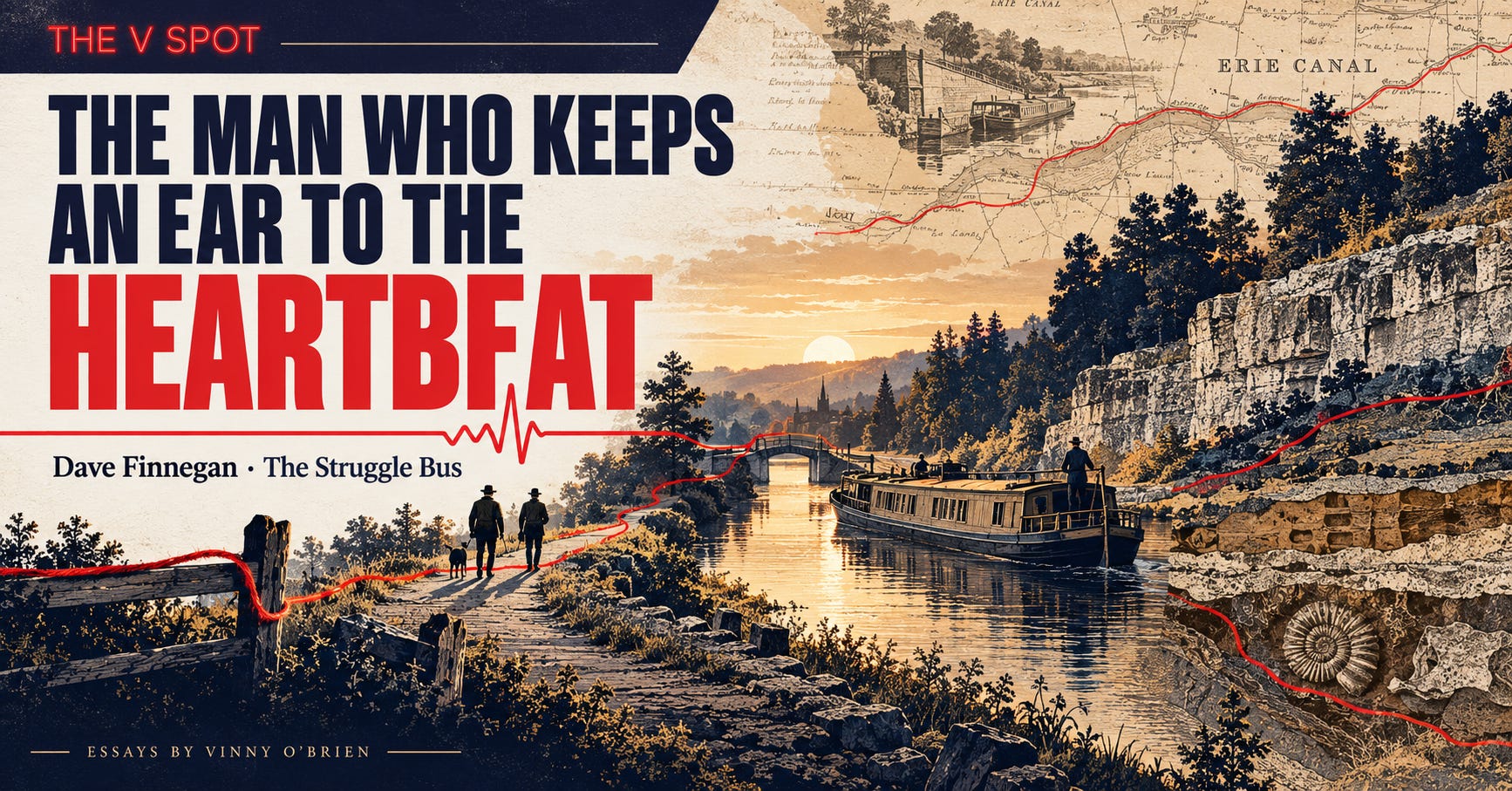
The canal connected Albany and Buffalo, with the Hudson providing the route onward to New York City. Built between 1817 and 1825, it changed access to markets and helped reshape trade. The project associated with Governor DeWitt Clinton had attracted ridicule.
Canvass White went to England in 1817 to study canals. He travelled more than 2,000 miles examining them and came home with drawings, instruments and knowledge he could put to work. His subsequent experiments produced hydraulic cement using American materials, helping solve a practical problem in canal construction.
.What caught Finn was the willingness to take responsibility for a problem. He had known the canal from his time living in southern Vermont, travelling through the Albany area. He hadn’t known White’s story. After I sent it, he went away and watched hours about him.
I love that detail. This is what a conversation with Finn can do: a story moves between people and acquires another life because somebody takes the trouble to follow it.
His observation was that progress comes when someone owns a problem that has remained unowned. White went looking for knowledge elsewhere, then applied it at home. Finn recognised the usefulness of learning from what others had already done.
“They learned how to build a canal by building the canal.”
That sentence is the learning moment of the episode. We talk about the willingness required in the early stages of AI, when experience is limited and people are learning through the work itself.
He also spoke about innovators inside established brands, willing to partner with the people building new things. The newcomer needs someone prepared to work with them.
Thinking about it since and a small hint of disappointment on the day, but there is a part of my original prework that I left too far behind when we recorded. I feel like I let Finn down byt you digging deeper on this. White’s knowledge helped create value for other people. The historical accounts also describe his struggle to receive payment for the use of his cement. Manufacturers benefited while he pursued compensation. The infrastructure succeeded. Its success did not translate into a fair reward for the person whose contribution had helped make it possible.I had written an invitation to all of us to be Canvass White in commerce. Looking back, I want to spend longer with what I was asking people to become. There is much to admire in his curiosity and his willingness to work. There is also a responsibility to ensure that the next person who brings something valuable back from the journey is properly recognised and rewarded.
We compressed a complicated history into a useful story about willingness. That helped us open a question. It should also encourage us to keep asking.
Who benefits from the thing we build? Who carries the risk while it is being built? And how do we keep the people whose work makes it possible inside the eventual story of success?
Those are my questions on returning to the material; I would like to put them to Finn. Want to do it again Finn? Canvass White? A new telling.
What a cable can mean to a father
In the conversation I brought up another story, much closer to home: Philip King speaking about a transatlantic cable and his daughters, who had moved to America.
The technology created a possibility that mattered to him. They could potentially come home with their children and continue doing their work from Ireland. It wasn’t necessarily going to happen. He spoke about the power of possibility.
A canal opens a route to a market. A cable creates the possibility of a family living nearer one another. We can describe both in terms of capacity and efficiency. We can also ask whose life becomes different because they exist.
That was the question I wanted to bring into our discussion of AI. What are we making possible? Who gets to benefit? What will we have left for our children when they begin making decisions about their own futures?
I have explored another side of this in Prisoners of Compute (yet to be released), an essay about the physical and institutional structures beneath AI: infrastructure, ownership, belief, and the people left carrying the cost. It deserves a life of its own.
The canal story gives that question a human face. The cable story brings it home to a father. Finn gives me a way to keep the people in view while I try to understand the machinery.
Finn’s historical perspective gives me somewhere to stand while considering those questions. When I asked how his interest in anthropology met his investment work, Finn said that at least half of the assessment was about the person. The idea and market fit mattered. So did the leader’s ability to attract others, take responsibility and build a team.
When we reached the song question, Finn chose Temple of the Dog’s “Hunger Strike”. He was careful about the choice. He wasn’t sure it described his entire life. He told me what it meant to him: remembering where you came from, and the people who got you there, as you become successful.
That personal reading brought us back to the beginning. The family. The aunties. The mentors. The people whose belief helped form the confidence we now see.
I left this episode thinking that his curiosity and generosity belong together. He learns from other people, remembers what they gave him, and brings what he finds back into the room. That is how knowledge becomes something shared. It is also how an industry can begin to feel like a community.
He has an ear to its heartbeat: the encouragement, the uncertainty, the small acts of trust that make it possible for people to keep going. His experience helps him hear those things. His character makes him respond.
For all the miles he travels, and all the history he studies, that is what I value most about Finn. He comes back with something for the rest of us.
We opened season three by considering the people who made us possible. We finished with a man who keeps making other people feel that more is possible for them.
And I think we left more on the table than we picked up.
I want to return to the canal, to the people who made it possible, and to the difference between creating value and receiving it. I want to explore how the routes we build change where people can live, who they can work with, and whether their families can be closer. I want to ask how we preserve that sense of belonging while the systems around us change so quickly.
Some of this belongs in its own essay. Some of it belongs in another conversation with Finn. All of it deserves more time than we gave it.
We need to explore this more, together.