

VirtualStock Vision Summit 2026 - my personal thoughts
Over the last few weeks, I have covered alot of ground, physically, learning wise and role wise. I thought it might be useful to share some.
Approx 27,000 KM covered. Physically. Speaks to itself, but I aged, visibly and added my Christmas blubber along the way. I don’t shed it quite as easily as I used to. Again, I am ageing gracefully. But approx 65% of the distance around the world. Or so I am LLMed. Learning wise, I firmed up my own opinions on much and many. I learned new things. I saw anxiety sit heavily on many and mostly listened. I was hosting for VisualStock in the WPP buildings in London, so it was fitting that Sir Martin Sorrell was our keynote speaker, is discussion with the brilliant Oliver Shah . Ollie didn’t need to provide too much runway. That discussion is one for a beer, a stormy night and much to debate.
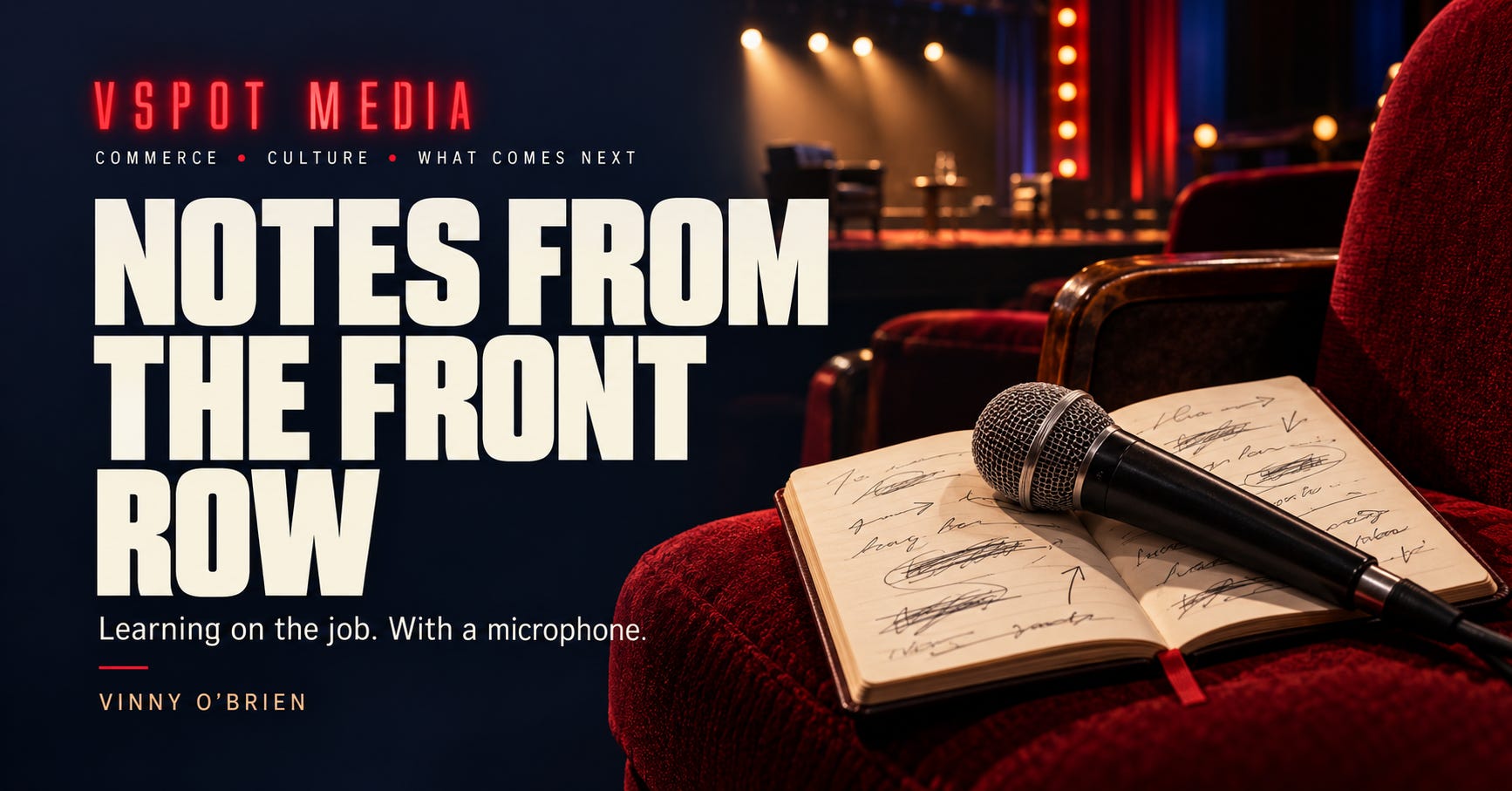
I was nervous enough being host but as I furiously scribbled between sessions, changing my notes, updating points of view it was interesting seeing the not so subtle changes that have occurred over the last few years. My role as host was not just to be good at pointing to toilets and getting people’s titles right, I felt obliged to set the scene. God help the audience. Over the course of the day alot of useful intelligence was shared. Fear, enthusiasm and finishing on a note of shared obligation. My notes read something like we start off observing history and now this is our change to start writing our own part in the history being written today.
On the Day……
You’re sitting in the front row, listening to every word, while also checking your notes, watching the clock, thinking about the next question, remembering someone’s name, wondering whether the next slide is coming, and occasionally having the terrifying realisation that in about 45 seconds everybody in the room is going to look at you. Again. It is a toss of a coin in these moments which I hate more - my voice or its just me. I deferred to my non irish accent. So so bland.
But I did listen differently.I wasn’t entirely sure what to expect. That wasn’t because I hadn’t prepared. I had. It was because we’re in this strange moment where everyone is trying to understand what AI actually means for commerce while simultaneously being expected to have an opinion on it.
I don’t think I’m alone in that.
In fact, sitting in the front row, adjusting my notes as the conversations developed, occasionally abandoning a question because something more interesting had just been said, felt like a reasonably good metaphor for where most of us are right now.
We’re learning on the job.
Perhaps slightly nervously. Virtualstock has since published its Vision Summit Playbook, which does a very good job of capturing the substance of the day: the speakers, ideas, themes and practical lessons. (Thanks to Becca Gibson for the faith shown and my friend Nicky Bowman for backing that too). I’m not going to recreate it here. It does that much better than I ever could. Instead, these are my notes from the front row. The things I scribbled down. The things that made me change the next question. And, more importantly, the things I’ve continued thinking about since. During the day, i preferred around 12 interviews too, to my depth of range here was useful, I think??
Start with Tuesday. Some stream of consciousness.
Virtualstock did something clever at its own event.
It took a back seat.
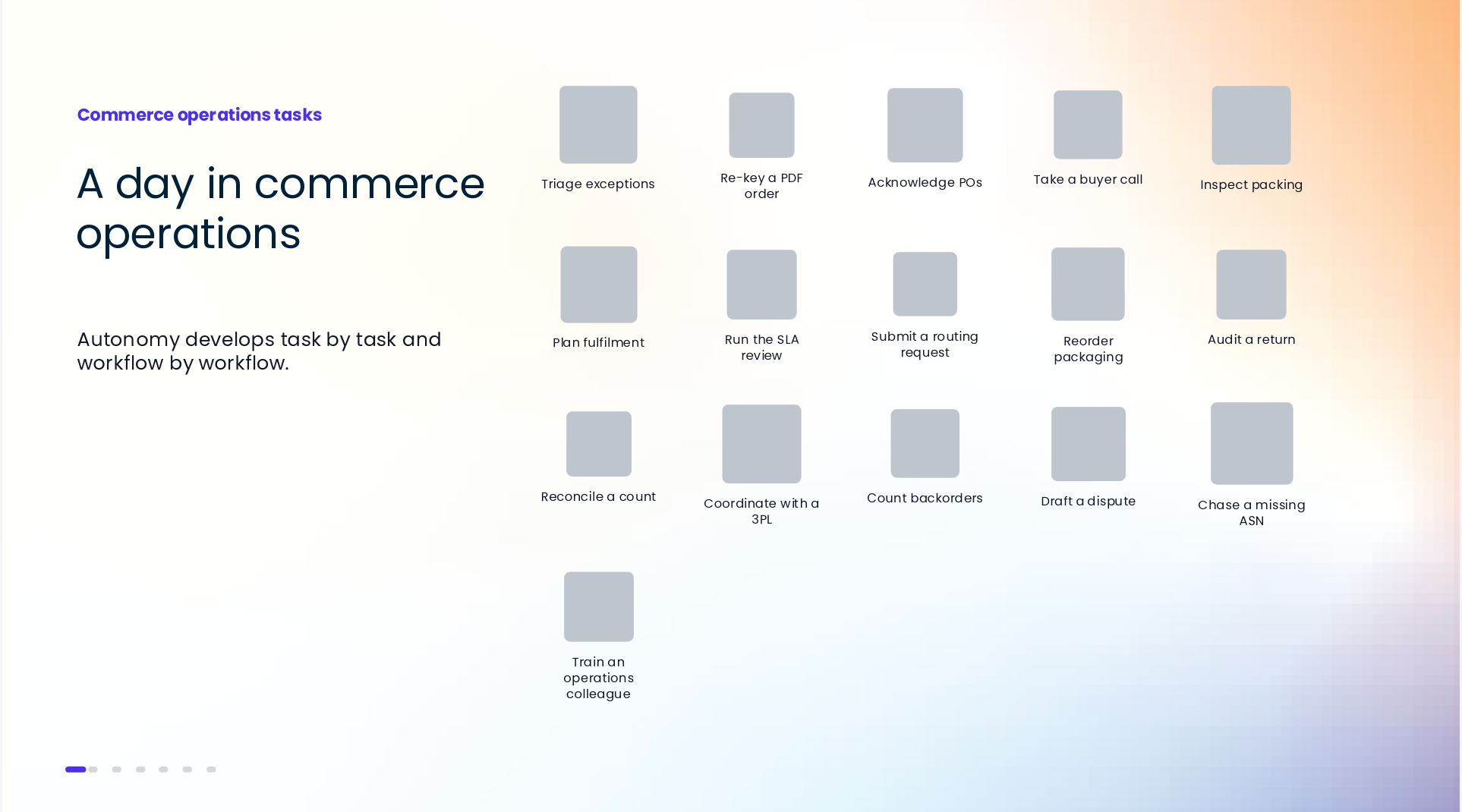
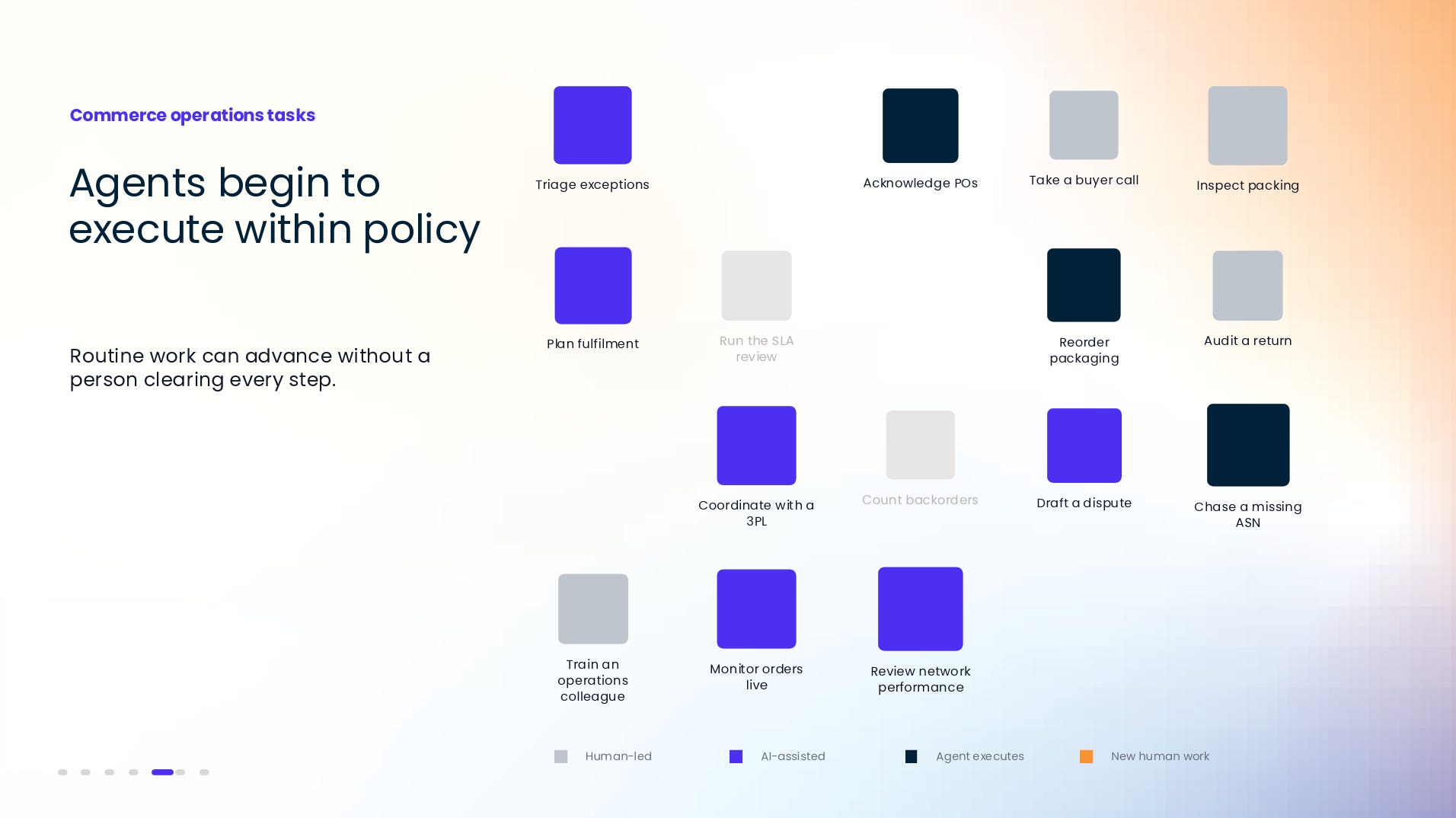
Omar Qari opened proceedings and gave us his perspective on where the market currently sits, but rather than beginning with some grand prediction about autonomous commerce, he started with something considerably more ordinary.
A day in the life.
Take someone in your organisation.
What does their day actually look like?
Not what their job description says they do.
What do they actually do?
What do they check first thing in the morning? Which systems do they open? What information do they move between them? Where do they wait? Who do they ask? What do they repeat? Where do they make a judgement call? Where are they doing something manually simply because that’s how it has always been done?
Then map it.
And do it again for another person.
And another function.
And eventually, the organisation starts revealing itself.
I found this remarkably useful. I think you will all do a version of this in 2027, or at the very least, you should.
Because we’ve become very good at starting conversations with:
“How could we use AI?”
Maybe the better first question is:
“How do we actually work?”
Only then do you start asking what should be automated, augmented, delegated to an agent or simply left alone.
There’s nothing particularly futuristic about mapping someone’s Tuesday.
That’s probably why I liked it.
Frameworks before tools
Linda Cereda a took that idea somewhere else. Linda spent more than a decade at Nike, and what struck me about her session wasn’t a particular tool or AI use case. It was the structure she put around the decision-making. She gave the room a practical framework for thinking about how AI tools could be applied rather than simply presenting another collection of things AI can now do. This was built in the world where “Just Do It” was the mantra. It was worth paying attention to. She now spends time training to this massive brain dump was a treasure trove for me.
Her distinction matters.
We’re drowning in capability at the moment. Every week there’s another model, feature, agent, browser, image generator or piece of software promising to remove seventeen people from your Monday morning meeting.
Capability isn’t really our problem anymore.
Choosing what is useful might be.
Omar’s session and Linda’s began to fit together in my head.
Understand the work first.
Then create a framework for deciding where technology genuinely improves it.
And already my notes for the day were changing. It was only 11.30am.
Then people started messing up my questions
This is one of the joys and mild occupational hazards of hosting. You prepare an elegant route through a conversation. Then somebody says something interesting.
Your beautifully prepared question number four is suddenly irrelevant and you’re scribbling something else in the margin while attempting to look like this was always the plan. My handwriting would not even be legible by a pharmacist anymore - damn computer. Komal Koul ’s session had some of that energy.
It was much more hands-on. Less theoretical. More of the reality of trying things, seeing what happens and learning from it.
But again, the thing I found myself writing down wasn’t necessarily about technology.
It was culture. Sounds familiar.
Listening to how the team at Currys operates, particularly around social, there seemed to be a collective understanding of the brand they were trying to deliver and permission for people to go and do it.
We talk endlessly about whether businesses are technologically prepared for AI.
I’m increasingly interested in whether they’re culturally prepared for it.
Can people experiment?
Can they get something wrong?
Can somebody say, “I tried this and it didn’t work,” without having to create a 47-slide deck explaining why?
Technology may move incredibly quickly.
Organisations generally don’t.
And I suspect that gap is going to matter.
The view gets wider
As the day went on, the conversations changed altitude.
Matthew Truman ’s discussion was particularly interesting because we got to hear how an investment vehicle thinks about where commerce is heading. And investment decisions are useful. (Matt is with True). Over 100 brands under their management and this was not fly by night discussion, it was thoughtful and considered.
Predictions are cheap.
Capital is slightly more opinionated.
Robotics and non-human intervention are clearly areas where they are investing and experimenting. Not because anyone knows precisely how these technologies will develop, but because there’s enough signal there to warrant finding out.
He was prodded about their recent acquisition of Argos. Cheaper than Alexander Isak BTW. .
Think about the access Argos already has to brands, categories and products.
Then think beyond today’s traditional idea of a retailer carrying a defined range.
Could that infrastructure allow Argos to become something closer to an on-demand category filler?
Range extension without necessarily thinking about range in the old way.
Brand extension.
Portfolio expansion.
A retailer becoming an access layer to a much broader universe of products. That is my read of it - not his precise words so do not quote him on that.
That’s interesting to me because it isn’t really an AI story.But, hs did leave us with Project Lemonade - IYKYK. It’s a story about technology changing what a retailer is capable of being. And by this point, my original notes were becoming increasingly useless.Which, for a host, is either a very good sign or an absolutely terrible one.
I decided it was the former.
And then someone mentioned five trillion dollars
Sorry, bac, to the start. I forgot this and I don’t want to rewrite the start, so here we are. Sir Martin Sorrell widened the lens considerably further.
There was history. Advertising. Platforms. Regulation. The emergence of the new AI incumbents.
And then there was the sheer scale of investment expected in the infrastructure underpinning all of this.
Trillions. 5 of them, between now and 2030 and a suggestion by many since that that will be an annual requirement by 2040. Try to get your head around that.
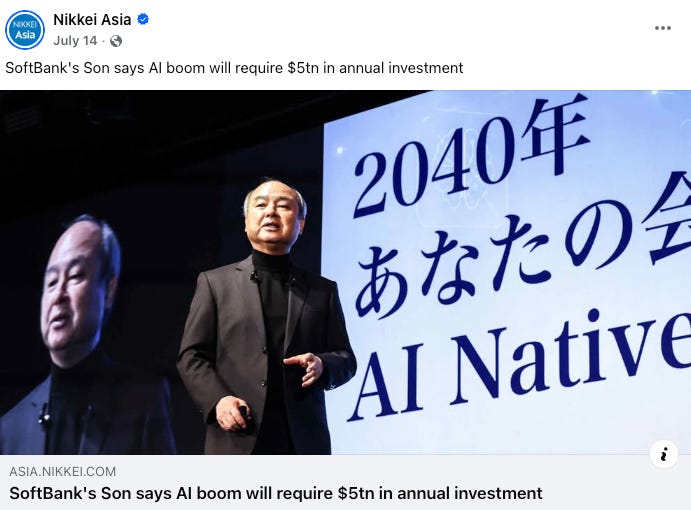
Whatever number we ultimately settle on from the recording, the magnitude is the important part.
You can believe agentic commerce is being overhyped.
You can believe today’s AI valuations are unsustainable.
You can believe half the demos we’ve watched will quietly disappear.
You may be right about all three.
But infrastructure investment on this scale makes one thing difficult to argue:
This isn’t going away.
We don’t know exactly what it becomes.
Some of today’s predictions will look ridiculous in five years. Some will probably look remarkably conservative.
Personally, I’m leaning towards AI ultimately being more impactful than we currently appreciate, even if some of the things we’re currently most excited about prove less important.
But then I am reading End Times Facism and The Nerd Reich so my mind is a bit twisted. .
And that distinction between what we know and what we’re currently guessing became another theme of the day for me.
The question I haven’t answered yet
One of the afternoon conversations left me with something I deliberately don’t want to neatly resolve here.
Shaje Ganny talked about our collective responsibility in all of this. We aren’t simply passive users of these technologies. Through how we use them, what we ask of them, what we accept and what we reject, we’re participating in their development. But we behave like we are passive. We think passively as individuals and more optimistically as workers. Go figure but we are responsible. For us and for those after us. We are stewards, lest we forget that are being asked to leave this blue ball better than when we found it.
That leaves me with a question:
What outcomes do we actually want?
I don’t have a sufficiently good answer yet.
I’m hoping to sit down with Shaje and explore that separately, because I think there’s something important in it. You on for a podcast Shaje?
For now, I’m comfortable leaving the question open.
There weren’t many definitive answers in my notebook by the end of the day anyway.
There were considerably more arrows, crossed-out questions and terrible handwriting.
Learning from the front row
And perhaps that’s my biggest takeaway.
I arrived to host a room full of people talking about where commerce is going.
I left with more questions than I arrived with.
I consider that a successful day.
Because nobody really knows how this plays out.
The people building the technology don’t know.
The people investing billions in it don’t know.
Retailers don’t know.
Brands don’t know.
And the bloke sitting in the front row frantically adjusting his questions certainly doesn’t know.
We’re all learning on the job.
Some of us just happen to have a microphone.
And maybe that’s not a bad description of this particular moment in commerce.
The sensible thing isn’t to pretend we know exactly where we’re going.
It’s to pay attention.
Map what we do today.
Create frameworks for making better choices.
Build cultures where people can experiment.
Watch where serious capital is being deployed.
Ask difficult questions about what we’re collectively creating.
And keep adjusting the notes as we learn.
There was one final thing I noticed.
For a day spent discussing automation, agents, robotics and increasingly non-human commerce, people seemed remarkably keen to spend the breaks talking to other humans.
Buyers met suppliers. Brands met operators. People who had wanted to meet each other finally found themselves standing beside one another.
There was no forced networking theatre.
There was food. There was wine. People talked.
And it worked.
Maybe there’s something reassuring in that too.
The machines are getting considerably better.
We still seem to quite like each other.