Weather Permitting: UK commerce breakdown
Every Silver lining has a cloud. The V Spot Ostrich Report · Q2 2026
The is the quarter Britain’s high street blamed on the sun, while the floor was quietly replaced underneath it.
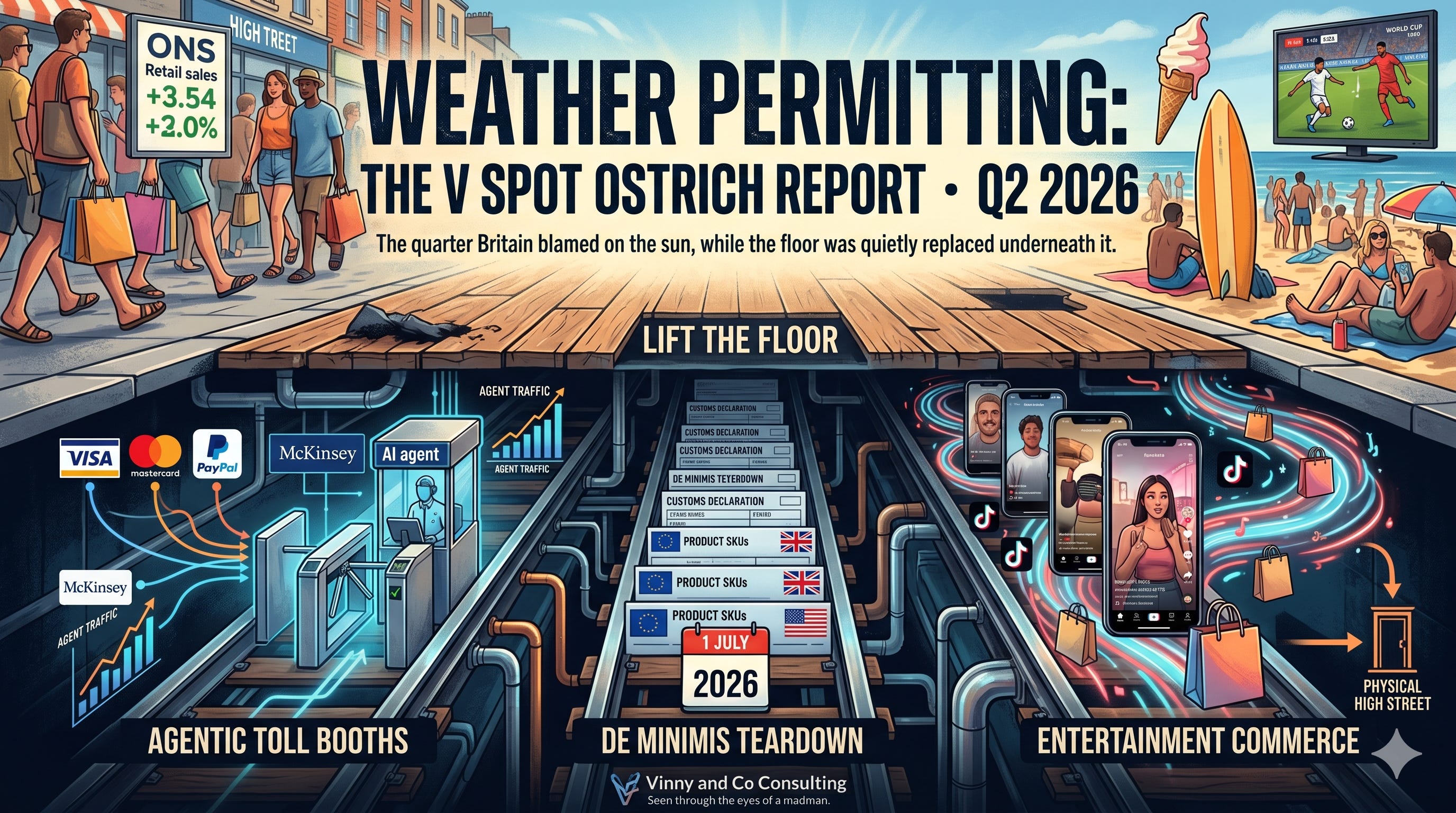
Britain spent the second quarter of 2026 staring at a thermometer. A near-record warm May, a World Cup kicking off in stadiums three thousand miles and five time zones away, the games landing in the middle of a British night so the fans credited with the demand bump were mostly asleep when it happened. You could not have designed a more on-brand summer for these islands: the one tournament being praised for stirring the tills is one almost nobody over here can stay up to watch.
And out of that came a number that everyone wanted to read as a recovery. The ONS clocked retail volumes up 1.2% in May, more than double what economists had pencilled in, with the online channel doing the heavy lifting at a 6.1% monthly jump, the largest since February 2025 and online’s strongest share of total spending all year at 28.8%. IMRG’s weekly index, narrated chart by chart on last week’s podcast, (Nice one Andy Mulcahy) told the same story from the other end: four weeks of positive year-on-year growth in a row, the first sustained run in a long while. Green shoots? It’s week 2 of the WC and the green shoots of optimism last week were met with reality this morning. Maybe its good that Bournemouth beach is closed? Day drinking after a game like that would not end well.
It just feels like It was a good fortnight in a trench coat.
Kevin Kelly has a line about how the big technological shifts tend to arrive less like decisions and more like weather, something latent in the conditions, waiting. The joke this quarter is that the weather was literal, and it did all the talking, while the things that will actually decide the next decade of commerce got bolted in under the floorboards where nobody bothered to look. So let’s do both. The surface first, because it is where your board is looking. Then the plumbing, because it is where your business is going.
The surface: A consumer who is resilient, not exuberant
Strip the heatwave and the football out of the IMRG numbers and you find the actual quarter, and it is not kind to the thing online retail was built on. Clothing is the patient. The ONS had clothing store volumes down 2.4% in April, their lowest since June 2025, with retailers themselves blaming variable weather, softer demand, and a consumer who has rediscovered the price tag. IMRG’s read agrees: menswear and womenswear did not so much as flinch at a heatwave, womenswear conversion is grinding along at roughly 2.2 to 2.5%, menswear at 1.8 to 2%, and clothing conversion overall has been drifting down since about 2021. The Black Friday spike that is meant to be a skyscraper on these charts now reads more like a bungalow.
Big-ticket is the other casualty. Furniture, sitting on an average basket of £300 to £400, has spent most of the year in negative growth, and the ONS keeps filing large appliances and furniture under “weak spot.” Garden is pure weather hostage, swinging from plus 68% in the hot weeks to minus 32% in the miserable ones, which makes it useless for trend and excellent for narrative. The one genuine green shoot is footwear, having a real 2026 after a poor 2025, kicking on into summer. Before anyone builds a strategy on it, note that “everyone bought trainers during a World Cup” is a story that ends the day the World Cup does.
The most useful tell in the whole quarter is the quiet one. On the total market, April orders fell harder than April revenue. Same money, fewer things in the basket. That is not a market buying more, it is a market buying carefully, trading up or down but definitely trading, and it lines up exactly with what the macro people are saying: the consumer is being held up by employment and real wages rather than by optimism, and younger shoppers just posted their least optimistic confidence reading in two years. Resilient, not exuberant. The difference is the whole game when you are planning autumn inventory and deciding how deep to discount. Welcome prime day to screw your plans.
That is the surface. Warm, choppy, weather-permitting. Now lift the floor.
Rail one: Someone is building the toll booths
While Britain debated paddling pools, the payment networks spent the quarter laying rails for a kind of commerce most merchants have not started selling into yet. In April, Visa shipped Intelligent Commerce Connect, a single integration that accepts payment across all the competing agent protocols at once. Mastercard pushed Agent Pay further out into the world, adding Hong Kong to its agentic network and folding its tokens into PayPal’s wallet. PayPal itself, having launched Instant Buy inside Perplexity late last year, is now wiring its merchants and millions of cards-on-file straight into ChatGPT.
Read that back. The card networks are not waiting to see whether you want an AI agent buying on your behalf. They are deciding, today, who gets to authorise it when it happens, and quietly installing themselves as the booth that collects the toll. McKinsey is dangling up to a trillion dollars of US agentic retail revenue by 2030, which is exactly the sort of number that turns a cautious roadmap into a land grab. An IBM study this year reckons 45% of consumers already use AI for at least part of the buying journey, and agent-driven traffic across the open web has grown more than 1,300% in nine months.
You can see it in the one platform that matters most to the people reading this. Shopify cleared its first hundred-billion-dollar GMV quarter in Q1, revenue up 34%, and Harley Finkelstein stood on the earnings call and called the company a “category of one” for selling inside ChatGPT, Copilot, and Google from a single system of record. AI-driven traffic to Shopify stores, he said, is up eightfold year on year, orders from AI search nearly thirteenfold. The market’s response to a near-perfect print was to mark the stock down on decelerating guidance, which tells you everything about the gap between what is being built and what is being believed.
Two cautions, because we cover AI as operators and not as boosters. First, the unsolved problem is fraud: an agent transaction strips out the behavioural signals fraud systems were trained on, and friendly fraud already eats an estimated $132 billion off merchants a year before agents make it worse. Second, the Karen Hao question, the one to ask of any “neutral” infrastructure story: who is building this, who funds it, and who collects at the gate. When Amazon blocked AI crawlers and watched 600 million listings vanish from AI results while Walmart hoovered up a fifth of ChatGPT’s referral traffic, that was not a technology story. That was a power story wearing a technology jacket.
This is the Agentic Storefronts thread we picked up back in Week 4. It stopped being a vision statement this quarter and started becoming a procurement decision.
Rail two: The teardown, running at three different speeds
If you have been ignoring the de minimis calculator on the Ostrich site, this is the quarter to stop. The single biggest structural change to cross-border commerce in a decade lands next Wednesday, and it lands in Europe first.
From 1 July 2026, the EU abolishes its €150 customs duty exemption and replaces it with a temporary €3-per-item duty, charged to the business rather than collected from the shopper at the door, with new mandatory product-identifier data following in November. This is the bit that should make every operator sit up: the duty is per line on the customs declaration, which means your ability to group identical items onto one line, and therefore the actual charge you pay, now depends on the cleanliness of your SKU, tariff classification, and origin data. Customs just made your product data discipline a pricing variable. The brands that treated SKU hygiene as a back-office chore are about to meet it at the border.
Here is the cross-Atlantic part, and it is a genuine three-speed divergence rather than a tidy global policy. The EU moves first and hardest, next week. The UK keeps its £135 relief through at least the end of this year and has only signalled removal around 2029, so for now Britain is the soft touch of the three, level-playing-field rhetoric notwithstanding. And the US, which kicked this whole sequence off by killing its $800 exemption last year, spent this quarter in genuine chaos: the Supreme Court ruled in February that the emergency-powers route to tariffs was never legal, the administration answered the same week by reaching for a different statute and slapping on a temporary 10% global surcharge, and the permanent de minimis repeal still does not fully bite until July 2027.
As we covered when the court broke trade policy and the sequel dropped the same afternoon, the chaos is not a bug in this story. The chaos is the policy. What it produces on the ground is an environment where landed cost is a moving target and the operators who win are the ones acting on real-time data rather than reacting after the cost has already changed. Shein and Temu built empires on the exemption that is now being dismantled in three markets at three different tempos. Watch what they do with forward-stocking and bonded warehousing over the next two quarters, because the answer is the new cross-border playbook for everyone else.
Rail three: The new front door is a from of entertainment
The third rail was articulated best not by an analyst but by a beauty founder on last week’s IMRG show. Sally from Rebel Rebel split the market into three buckets: speed and convenience, where Amazon and the marketplaces live; the omni-channel high street, where the post-COVID shopper still wants to touch and play and where the drugstores are quietly flying; and a third, newer bucket she pointedly refuses to call social commerce. She calls it entertainment commerce, on the logic that people arrive for the entertainment and shop almost incidentally, and that nearly nine in ten of them buy while they are there.
The numbers back the rename. eMarketer has US social commerce passing $100 billion this year, up around 18%, with TikTok Shop alone at roughly $23 billion in the US and $87 billion globally, having doubled in a year. It is the fastest-growing channel in modern retail history, and its engine is not search but discovery, products surfacing inside content rather than waiting to be looked for. Sally’s sharpest point was the halo: things featured on TikTok Shop are lifting sales in her other channels, physical and digital alike. The front door is moving, and it is moving to wherever attention already is.
This is the live edge of the discovery argument I made in Found in Translation. For twenty years ecommerce assumed a shopper who knew what they wanted and typed it into a box. Both new rails, the AI agent and the entertainment feed, assume the opposite: a shopper whose intent is formed in the moment, by a model or by a creator, somewhere upstream of your website. If you are not legible to the model and not present in the feed, you are not in the consideration set, and no amount of conversion-rate optimisation on a page nobody reaches will save you.
One aside, filed under the quarter’s better ironies. Asked how she actually uses AI day to day, Sally named Claude, repeatedly, as the tool drafting her presentations, writing copy, and helping build the websites. The agent that will one day check her customers out is still a vision. The assistant that already runs her week is sitting open in a browser tab. That gap, between the agentic future on the slides and the assistive present in the tab, is the truest picture of where AI in commerce actually is right now.
What this means for the merchant on the ground
Stop running the business off the weather. The hot fortnight pulled demand forward, which means some of your strong May was borrowed from a June and July that will look thinner for it. Plan the back half for a consumer who is steady and sceptical, not one who is coming back to the boil.
Then spend the time the quiet quarter buys you on the three rails, because two of them move from “coming” to “Tuesday afternoon” before the next Ostrich. Audit whether ChatGPT, Perplexity, and Google’s AI mode can find and correctly describe your products, because that is now a traffic source growing in multiples, not a science project. Get your customs data, SKU structure, and country-of-origin in order before EU de minimis bites next week and turns sloppy product data into a line-item tax. And decide, deliberately, whether you are building a presence in the entertainment bucket or ceding that front door to whoever does.
The delivery point from that same IMRG episode threads straight through all of it. InPost’s argument was that giving the buyer a clear delivery choice up front, the way checkout already offers them a choice of how to pay, converts better and fails less often than forcing an option on them at the end. That is the friction-as-strategy idea we keep returning to: the deliberate, well-placed bit of choice is not a cost to be stripped out, it is the thing that earns the sale. The same logic now applies to every one of these rails. The winners will not be the ones who remove the most friction. They will be the ones who put the right choice in front of the buyer at the right moment, and own the door it sits on.
The weather will break. It always does, and when it does the clothing softness and the big-ticket freeze will still be sitting there, exactly where the sun briefly hid them. The three rails will not break, because they were never weather-dependent in the first place. So the question for the second half of 2026 is not whether the consumer comes back.
It is whether, when they do, they arrive through your front door or someone else’s checkout.
The V Spot · Vinny and Co Consulting · Tralee, Kerry. Surface data from the ONS Retail Sales bulletin (May 2026) and the IMRG weekly online index. Rails from Visa, Mastercard, PayPal, Shopify Q1 results, McKinsey, eMarketer, and the EU customs reform guidance. Seen, as ever, through the eyes of a madman.


