

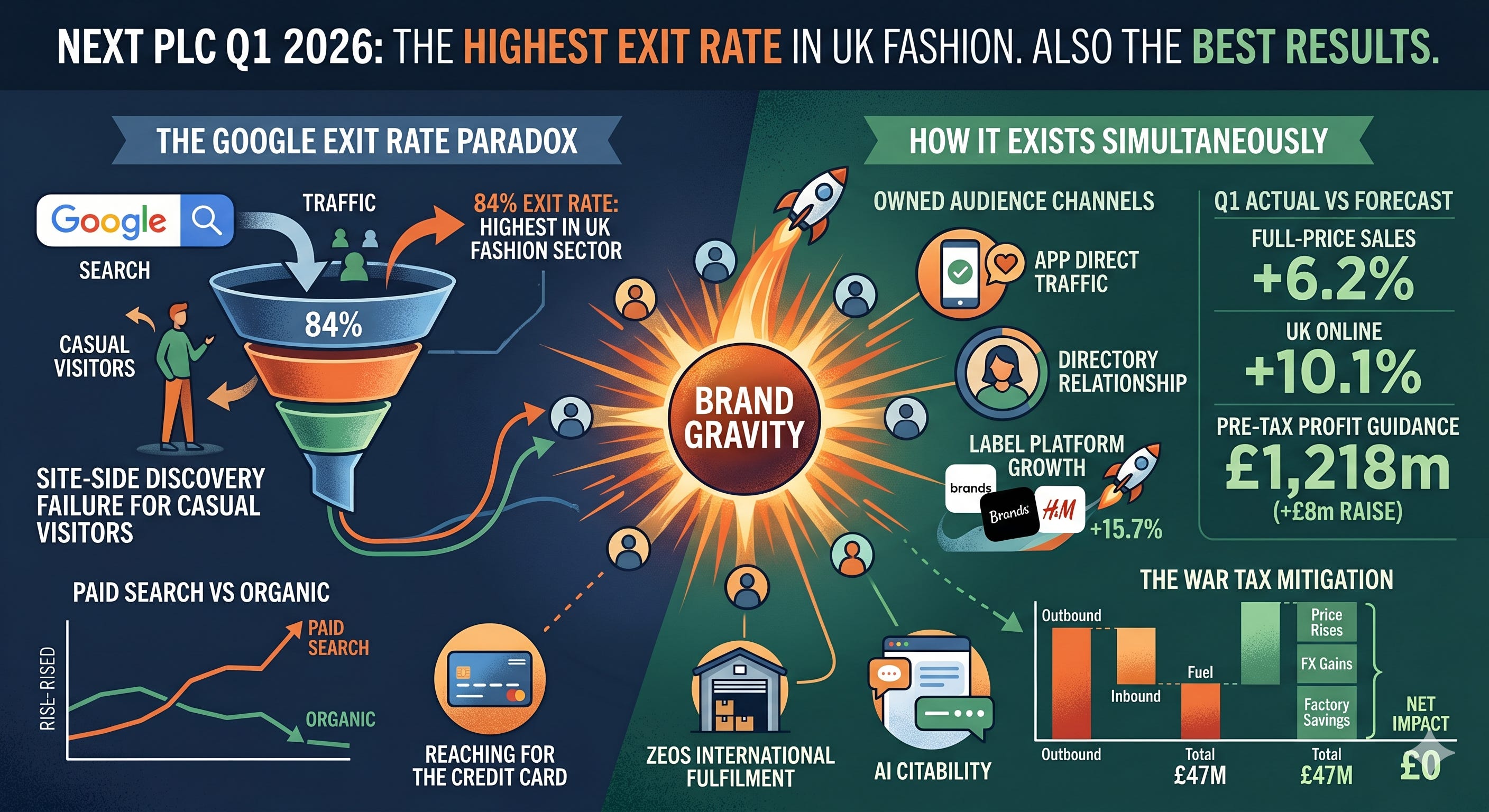
There is a number in the Mapp Fashion Intelligence Report that should be in your head more than it does.
Next’s Google exit rate: 84%.
Five out of every six visitors who arrive at Next via Google leave without buying. In the Mapp dataset, 397 retailers, 7 markets, 53.7 billion visits, that is the highest exit rate in the sector. River Island at 79%. Primark at 79%. Next at 84%. The report I wrote last month cited this as one of the “clearest signals of site-side discovery failure.” I stand by that characterisation. The discovery model that built UK online retail is breaking, and these numbers are part of the evidence.
Next reported Q1 full-price sales up 6.2% this morning, beating its own 4.0% forecast by £28 million. Online grew 10.1% in the UK. The LABEL platform, third-party brands hosted on Next’s infrastructure, grew 15.7%. Full-year pre-tax profit guidance raised to £1,218 million. Shares up.
So: highest Google exit rate in UK fashion. Best results. Profit guidance above £1.2 billion. How do those two things exist simultaneously?
The answer to that question is probably the most important thing happening in UK retail right now, and almost nobody is saying it clearly.
The rabbit hold revisited
The context matters. In The Rabbit Hole Got Deeper, I laid out the structural case for why UK online retail is in genuine difficulty. The IMRG data covering March 2021 to early 2026: conversion baseline drifting relentlessly downward, from around 4% to sub-1.6%, with March 2026 session conversion rates down year-on-year from 1.72% to 1.59%. CPA rising 22.53% in the same period.
The Mapp Fashion Report, 397 retailers, Sarah McVittie’s work, the most rigorous dataset available on UK fashion discovery economics, delivered the verdict underneath the chart. Paid search nearly tripled its share. Organic contracted 4.1 percentage points. The industry looked at a declining organic position and instead of asking why, reached for the credit card. Paid search added 3.2 billion visits, a 264% increase, while organic barely moved.
The financial consequence is the danger zone: brands running paid at 4-8% of their traffic mix produce average operating margins of 3.7%, improving in only 48% of cases. They are paying full auction prices for discovery they used to earn. The maths doesn’t work.
And in that same dataset, Next’s Google exit rate is 84%.
Huh?
Here’s why the 84% exit rate and the £1.2 billion profit are not contradictory. They are, to me, the same story.
Next’s Google exit rate being the highest in the dataset doesn’t mean Next has the worst site. It means Google is the wrong entry point for Next’s customer. A Next customer who arrives via Google is typically arriving with a specific, narrow intent, a particular search term, a competitor comparison, a price check. They didn’t start at Google because they wanted to browse Next. They started at Google because they were shopping the category. For that visitor, Next’s site is not where they want to end up. They bounce.
The Next customer who converts doesn’t arrive via Google. They arrive direct. They arrive via the app. They arrive because they have a Next account and a relationship with the Directory. They arrive because a friend mentioned it. They arrive because they just got a Next Finance statement and clicked through. They have, in the language of the Mapp report, brand gravity, and brand gravity doesn’t show up in the Google exit rate. It shows up in the direct traffic, the repeat purchase rate, the LABEL platform numbers.
This is the point about owned audience I made in the Rabbit Hole piece, and it is perfectly illustrated by the Next paradox. The brands that will be fine are the ones that built genuine direct relationships before the market changed. Next is the case study.
The 84% Google exit rate is a symptom of a brand that has successfully moved most of its customer relationship to channels Google cannot see.
